That will be very difficult but if you download their annual reports and go through the financial statements you may get a clue.
A few years back Bob Brown did a study of TCA ( formerly the Forest Protection Society) and found that 95% of their funding came directly from industry contributions.
I was around when the Forest Protection Society was started and all the workers where I worked were ordered to go to a meeting that night and join the FPS. Very democratic indeed.
Posted by Pete Godfrey on 10/02/10 at 03:46 PM
Pete Godfrey, #1, is spot on. During a FPT hearing in 2002, we found via Bob Burton that NAFI was providing over 90% of FPS/TCA funding, and that the total subscription revenue from its claimed membership worked out to less than 10% of what it should have been. This is notwithstanding the coercion we kept hearing about.
It is still uncertain if dishonesty is a formal policy.
John Hayward
Posted by john Hayward on 10/02/10 at 05:26 PM
from “Crime, fiction and political intrigue” (by Chris James in ‘Online Opinion’):
“In 2004 Greens Senator Bob Brown outlined some of the activities of Timber Communities Australia as well as some of its sources of funding. This is what Senator Brown had to say about the TCA:
When articles on the forests appear in print or go to air, there is an outcry from the forest industry. But what at first appears to be a broad based response to a media story is, in fact, a highly orchestrated campaign by a small cabal long linked by personal history and involvement with the woodchip industry and using an innocuous-sounding organisation called Timber Communities Australia, as a front to give it credibility.
Since its inception in 1987, TCA has been positioned as the voice of the little people caught between the conservation movement, governments and the large woodchip companies. It purports to be the authentic voice of those who are merely seeking to make a living and keep their jobs, to feed their families. Its advertisements feature stereotypes of the hard-working family - craftspeople, bee keepers, people in truck-stop cafes and children in the bush with their grandparents. Its web page says it is a grassroots organisation which “exists to encourage the sensible, balanced multiple use of our forests for the benefit of all Australians”.
The Senator goes on to say:
In fact, it is the brainchild and mouthpiece of NAFI, [the National Association of Forest Industries], headquartered in Canberra, the lobby group of Australia’s logging and woodchip corporations. NAFI and Timber Communities Australia share a common headquarters in Canberra and a common executive director …
Senator Brown told the Senate that the financial returns for TCA revealed its lack of grassroots support:
In 2001-02 only 4 per cent, or $43,630, of Timber Communities Australia’s income came from its members. Seventy-six per cent, or $730,000 out of $965,498, was from direct industry contributions. In the following year, 2002-03, direct contributions from industry to TCA rose to 86 per cent - $734,154 of the total of $838,977 - and, conversely, member contributions fell by $4,228 to only $39,402.
NAFI’s in-kind contributions to Timber Communities Australia, by way of space, salary and administrative assistance, were valued at a further $67,891. In other words, industry contributions pay the wages of … Timber Communities Australia’s ubiquitous Tasmanian spokes-person, and eight other staff around Australia.
Senator Brown’s speech drew the attention of Queensland Senator and Minister for Fisheries, Forestry and Conservation, Ian Macdonald who responded with:
Timber Communities Australia is a magnificent grassroots organisation. It is a group of ordinary Australians - if you can call them that - working in the industry, working in country communities, who are eventually getting their message across about the hypocrisy of the Greens and their very left-wing agenda.
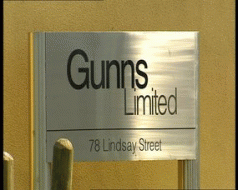
According to the Source Watch Organization, Timber Communities is closely linked to and partly funded by the Forest Industries Association of Tasmania, which is in turn funded by timber industry corporate players, predominantly Gunns”.
A long standing TCA member is the pivotal Meander Valley Councillor and long term supporter of logging in the Shire, Mayor Shelton.
Mayor Shelton is now standing as a Liberal candidate in the upcoming State election.
As Mayor he and his pro loggiing Council authorised the destruction of three key trees on the Green at Westbury at a cost of $27,500.
He might like to answer through your excellent columns to whom this enormous sum was paid and if the Contract was put out to Tender.
I have removed a considerable number of both Radiata’s and Macrocarpa’s for well under $3000 each in both NSW and Tasmania.
Posted by john hawkins on 10/02/10 at 09:15 PM
John, I could make an educated guess who did the job - but not for public consumption. Contact me at .(JavaScript must be enabled to view this email address) and I will let you know what I reckon.
Posted by Garry Stannus on 11/02/10 at 05:51 AM
And while a writer is asking questions about funding, and organisations, and several correspondants are mentioning Bob Brown’s interest in TCA, I would like to ask is anyone following the money trail in the Wilderness Society? Is anyone doing a runner with the funds? Is anything being squirrelled away, to be beyond reach if a spill of positions and a shift of power balance were to occur?
Would anyone who has direct debit contributions to the Wilderness Society coming out of their bank accounts be feeling uneasy about what might be happening? It might be an idea to suspend those deductions for a while…
Posted by George Harris aka woodworker on 11/02/10 at 08:01 AM
Woodworker,
With similar intent how busy is the shredder in Bartlett’s office? I am afraid he is gone for all money.
How soon before the ANZ calls in the Liquidators to Gunns offices?
How is Forestry Tasmania and Gunns going to survive FSC?
When can we expect another Royal Commission into corruption of due process over a Pulp Mill.
Can Labor really expect the Union man who turned down Latham’s 800 million to stop old growth logging in exchange for restructuring, to be elected by his contractors now deserted by Gunns?
How much will Gunns be prepared to spend to keep the Lib Lab show on the road, etc etc?
As the voice of the timber industry on this site your notably forthright comments wil be of great interest.
Posted by john hawkins on 11/02/10 at 03:41 PM
Didn’t Mark Shelton go cleanskin when he transferred to the Osmaston Resource Management Group?
Like the Meander Resource Management Group and other RMG subsidiaries of the TCA, this mob works tirelessly to save our catchments from the clutches of conservation, with outstanding success.
Shelton represents the exciting stooges offered by the Libs this time around. As smart as Sturgo and as honest as Thuggo, the man could well be the Pericles of Tasmania’s Golden Age.
John Hayward
Posted by john Hayward on 11/02/10 at 04:03 PM
John Hawkins, #4, should have compared the relatively modest blow-out of felling the trees with the $80,000 being given to the TCCI to study how much more the Tas Govt should funnel to them via the siphon known as the Tasmanian Education Foundation. As with the old TCC and the pokies industry, such parasitism is part of the Tassie way of life, as Barty wisely pointed out.
John Hayward
Posted by john Hayward on 11/02/10 at 04:40 PM
John Hawkins, (#7), I note that neither you, nor anyone else, has risen to address directly the questions I raise in #6. Can’t you face up to the possibility that abuse of process, possible misappropriation, poor governance, lack of democracy and thuggishness are realities in the way the Wilderness Society is being run? And what of the closeness of the Wilderness Society and the Greens, and Green candidates? Does that give you concerns about how it looks, now that a state election has been called? Doesn’t it make the criticisms of the state government look a little hollow and disingenuous?
Now let me address the $800 million Latham compensation you keep banging on about. It was peanuts! Do you really expect an industry that is the largest single sector in the state’s economy to be bought off with such a paltry one-off amount? Consider the numbers. The timber industry has had an annual turnover of between 1.4 and 1.7 BILLION dollars a year, year after year. It directly employs nearly 6,000 Tasmanians, and has a multiplier effect of around 1.6, and is the lifeblood of many rural communities around Tasmania that would struggle to exist if it were to be removed. Then there is the downstream processing sector, and the manufacturing sector and the consumer sectors beyond that. Sawn timber and timber products are major exports from Tasmania, and they contribute significantly to the state’s economy, but also the domestic building industry is a significant consumer of timber that needs to pay for its imputs. If Tasmania had to import timber, its economy would have to be able to support that. Removing the timber industry would cripple the economy, and the paltry $800 million would have gone nowhere. It would have barely compensated the value of capital investment in timber industry infrastructure, let alone adequately compensate the many individuals whose jobs would have been strangled by the green noose.
How about you address the question I raised in post #6
Posted by George Harris aka woodworker on 12/02/10 at 09:28 PM
Well, they’ve had enough time by now. No response.
Posted by George Harris aka woodworker on 13/02/10 at 10:47 PM
Three more days and still no response…
Posted by George Harris aka woodworker on 16/02/10 at 10:08 PM
Show Comments
Comments (12)