A comment on Tasmanian Times regarding a recently published article, in which I suggested the need for a campaign to rescind the legislation that places Gunn’s pulp mill proposal above the law, raised the question of what other legislation is involved. First the particular law relating to Gunns is an immediate issue that Tasmanian Parliament can act on(1). Given that our new Premier is talking publically in favour of underwriting the Gunn’s Mill project and compromising many milllions of dollars of public money this is an urgent issue requiring public pressure to stop irresponsible State Government action. Giving more millions to this economic and ecologically dangerous mill proposal would seriously harm Tasmania ‘s future prospects.
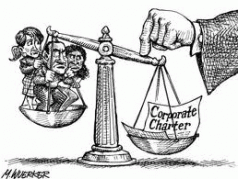
As to the question of other laws involved this is an important but much more complex matter that involves National laws and policies as well as International issues. What is involved includes laws giving corporations the status of an individual person but with far more rights than any individual citizen.
Michael Tubbs a retired barrister with extensive practice in Corporation and franchise Law as it applies to business generally has written widely distributed papers on these matters. Michael Tubbs points out that these laws raise corporations to the status of citizens but with far more power than any genuine citizen has in real life. The drastic negative effects of these approaches to law on real citizen’s lives was demonstrated in the ABC’s Four Corners program on February14 2011. The program revealed how Gas from Coal corporations have power over the land of farmers and are destroying farms, living habitats and the underground water system with their poisons.
Tubbs points out that laws involved include a law passed by the English parliament namely the English Company Act 1900. The law gave the corporation (company as they were originally called) an independent legal, though “artificial,” personality all of its own. A similar law was apparently passed in Australia in 1903. And there has been further development of this type of law in 1922 and since.
To digress briefly —another practical example of one of the many negative effects of the law making corporations citizens with far more rights than genuine citizens, is revealed in Jerome Tuccille’s 1989 auto biography of Rupert Murdoch. On page 61 of this autobiography Tuccille writes “As Murdoch himself explained it, the over lapping partnership structure allowed him to reinvest profits back into his various operations instead of being required by the banks to pay out dividends to share holders. In this way, “ Murdoch said, “a central bank in London or Australia can’t order you to pay dividends, since you don’t have control stock. It means you can plow back profits” (2)
In other words certain legal anomalies give corporations chiefs power over other people’s money. This mean, and apparently quite legal, trick used by Murdoch is a variation of the control the ABC Four Corners program revealed that Gas from Coal corporations have over farmers and their land. How do they get away with it? Partly because Murdoch and people like him have so much power over the mass media. But it is more complex than that, the ideology of economic rationalism, neo liberalism or economic fundamentalism, what-ever you choose to call it, holds sway in most economic and political cultural areas. The lie that greed is good is very pervasive.
To return to the questions as to what other laws are involved in corporation control over our lives the answer is there are a number of laws involved and it is very complex field. Thus a proposal to act locally by repealing a corrupt and corrupting law made by our local Tasmanian Parliament appears to me as a good starting point. This does not mean we can ignore other corrupt and corrupting laws it does mean that we can act locally while seeking to get a better handle on the local national and international laws involved. A little run for the widely voiced but all too seldom practiced idea advocated in the slogan “think globally act locally”.
There are other important aspects to this whole issue of corporation power over governments and people. For example should a few individuals be allowed to act together as a corporation to accumulate massive unearned profits and use the massive amounts of capital so accumulated to destroy the lives of others and even the possibility of a future for humanity? Does not this accumulation of capital and the power over governments and people that comes with such accumulation give, to a few corporation chiefs, an immoral and undue power over others?
My view is that if we are to end corruption we need to change the economic and the social and legal practices that make the corruption possible on such a massive scale.
Again this is no small undertaking and by working to win positive gains at a local level we can make a realistic contribution to a better world. We do indeed need to think globally and act locally rather than merely shout the slogan while refusing to face up to local, national and international realities that are staring us in the face.
The amendment to existing law that placed Gunn’s Mill project above the law is but part of a widespread practice of governments doing what they are told to do by powerful vested interests. Large corporations, that control massive capital assets and have undue legal powers, are able to influence governments to act against the public and humanities current and future interests. The Gas from Coal issues — the shareholders denied dividends by Murdoch —- as referred to above are examples. We could add—Tim Flannery’s assertion that “ the pesticide companies had set us on a cataclysmic course(3) as just one of many further examples. In other words large companies now organized as corporations actually spell corruption of governments and are threatening the human future.
The corporations have controlled governments over recent decades; the outcomes have been tragic and threaten even worse disasters. Informed people movements for fairness and people equity that will not tolerate ongoing corporation controlled government betrayals of people’s interests is the great need of our time.
NOTES
(1) The legal dispensation for Gunns:
PMAA Clause 11: Limitation of rights of appeal
1. Subject to Subsection 2 and notwithstanding the provisions of any other Act
a. a person is not entitled to appeal to a body or other person, court or tribunal; or
b. no order or review may be made under the Judicial Review Act 2000; or
c. no declaratory judgment may be given; or
d. no other action or proceeding may be brought in respect of any action, decision, process, matter or thing arising out of or relating to this Act.
2. Subsection 1 does not prevent a review of any action, decision, process, matter or thing which has involved or has been affected by criminal conduct.
3. No review under Subsection 2 operates to delay the issue of the Pulp Mill Permit or any action authorised by that permit. Comment by M..B. 3 as immediately above ensures that even criminal acts by people representing Gunns must not be allowed to stop the project or even slow it down. The whole law change can only be described as outrageously unjust and even life threatening to peaceful protestors whose economic future, health and or life style will be destroyed if the mill project goes ahead.
(2) see Tuccille Jerome “MURDOCH A Biography’page 61 Edition pub. in Great Britain by Judy Piatkus (Publishers) Ltd in 1990 )
(3) See Flannery Tim “Here On Earth” page 168 Pub. Text Melbourne 2010