Neil Smith
TEN years ago, the Tasmanian government and forest workers, with the connivance of officers of Tasmania Police, flouted their own Occupational Health and Safety laws for the apparent purpose of intimidating a treetop protester (me) who was in the path of planned roading … 
800 rally
Coupe HU307 at Mother Cummings Peak near Meander was the first post-RFA battleground involving conservationists and a government determined that the conservation movement should be forced to die out. Determined that everyone should concede that the Regional Forest Agreement signed by Tasmania and the Commonwealth on 8 November 1997 indeed struck a reasonable balance between the needs of conservation and industry development (which in practice meant unlimited woodchipping). Conservationists thought otherwise, and in fact felt badly cheated in that just days before the signing, they had been assured that the overall outcome would be much more favourable.
The protest over this particular forest arose spontaneously within the local community and was not orchestrated by any conservation body (although of course we were supported). The “rent-a-crowd” was there of course (although “rent” in this sense is a peculiar word since the cost of the rent is always zero. Friends of forests everywhere will always rally in support of their fellows in other regions and States when and as they can). Many residents of the Deloraine-Meander-Caveside area, of all ages and occupations, had serious aspirations for their region, aspirations not furthered by rolling over in the face of an ever more rapacious woodchip industry and bully tactics by the government. HU307 had very significant special conservation values, and had been reserved under the previous interim RFA. Here was the line in the sand.
A little like the situation now facing the people of the Tamar Valley. In the case of Mother Cummings the direct threats to air, water and property values were obviously not as dire. But any government claiming to be credibly responsive and representative needs to realise that most people feel the need for more than the basics of food, housing, employment and health services, and endless kitsch man-made bread and circuses. Many have an affinity with land and place which cannot be denied. That’s widely accepted in the case of indigenous people, but they are not alone.
I had the honour of becoming the most recognisable public face of the campaign when I erected a tree platform in the path of a proposed road and whilst in residence there sent out regular emails via a laptop computer and cellphone.
Roll back to 1998 … (material from the website of the time)
Locality
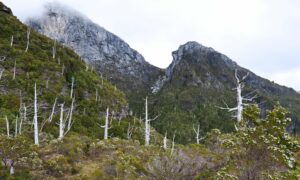
Mother Cummings Peak is located in Tasmania, the island State of Australia, at south latitude 41 degrees 41 minutes, east longitude 146 degrees 33 minutes. The summit is 1255 metres above sea level. The village of Meander is located 6km to the north-east and the nearest sizeable town is Deloraine.
The summit itself is protected within the Tasmanian Wilderness World Heritage Area, but the northern and eastern forested slopes which form the natural ecological continuum are “multiple-use forest” and available for timber harvesting. A large bench at 700 metres altitude on the northern side is designated as coupes HU306A, B and C. The A coupe has now been clearfelled, and the “rubbish” remaining after sawlog and pulpwood extraction was burnt on Friday 17 April 1998. The B and C coupes are due to be clearfell logged shortly.
Coupe HU307
Another forested bench at the 850-metre level on the eastern side of the peak had been campaigned for vigorously by conservationists during the two-year period of negotiations for the Tasmanian Regional Forest Agreement (RFA). The RFA was signed by the Prime Minister of Australia and the Premier of Tasmania on 8 November 1997, and handed over this forest (along with most other Tasmanian forest not already reserved) to the woodchippers. This was in spite of the prior recognition in the Interim Forest Agreement of the high biodiversity values of this bench which resulted in its being set aside from logging while the RFA was negotiated.
“Coupe HU307” was notable for
• never having been logged (much surrounding forest had been selectively logged prior to the 1950s) and containing many old-growth habitat trees, including breeding habitat suitable for the endangered wedge-tailed eagle (Aquila audax fleayi) which was present in the area.
• containing two recognised forest types (tall and dry Eucalyptus delegatensis) whose old-growth phases were inadequately reserved (according to the governments’ agreed targets) both before the RFA and after the RFA.
• containing a unique sphagnum bog community
• containing relictual King Billy pines (Athrotaxis selaginoides), probably the north-easternmost extant examples.
• being located on top of a sandstone stratum which was demonstrably landslip-prone. In the near vicinity are several landslips at the same level, at least two of which were probably caused by older forestry roading.
• its significance to a growing local indigenous community seeking to re-establish its links to the land and to ancestral sites, and trying to create employment through cultural tourism.
• being an existing eco-tourism resource, relatively accessible, and having further such potential – in a region of Tasmania whose economy focusses largely around tourism and is not greatly dependent on forestry industry.
Campaign preparations
After a flurry of representations to politicians and attempts to raise public awareness through the media, a group of conservationists set up camps in and near coupe HU307 at the end of February 1998 in the days preceding the start of logging . “Hector”, assisted in carrying and depot establishment by a team of seven, erected a platform surrounding the trunk of one tree at the 25-metre level, and occupied this from the night of Sunday March 1st. Others prepared concrete “dragins” along the access road to allow people to lock their bodies in place to prevent trucks and earthmoving machinery gaining access. Various small-scale roadblocks using large rocks and the like were put in place.
Loggers in!
However, on Tuesday March 3rd, workers from Forestry Tasmania were able to get a small car around the blockages to ferry chainsaw crews to the coupe. That afternoon there occurred an uncontrolled orgy of destruction with up to 100 trees of various sizes being felled along the proposed road extension leading up to Hector’s tree. There was scant regard for human safety, the saws going almost continuously in spite of protesters going in and out of the danger area. The very first tree felled was a large one, nearby and directly towards Hector in contravention of workplace health and safety regulations – in an apparent attempt to scare him down. Many police officers stood by.
In succeeding days a more reasonable effort was made to ensure safety, but the cutting of the roadline continued, although greatly hindered by “black wallaby” activists who deliberately placed themselves near the intended working area. Passage of vehicles was still hindered on Scotts Road by roadblocks including one person chained to a buried dragin through the floor of a parked car. Eventually a replacement road was built around the car.
First police arrests
On Thursday March 5th the police commenced arresting protesters for trespass after Forestry Tasmania had declared an “exclusion zone” covering coupe HU307, Scotts Road, and their surroundings to a distance of 100 metres. As activists were caught and arrested they were placed on police bail to appear in court at a later date, a condition of bail being that they did not return to the area. As it was believed that penalties for breach of bail conditions were substantial, most did not return and the numbers available for “black wallaby” duty steadily decreased. With the road being cleared of substantial obstructions including the protester in the car, an excavator was able to reach the coupe and it began earthmoving operations on the new roadline with alarming rapidity. A log bridge was built across the small stream near Hector’s tree.
Developments
Other techniques employed by protesters to delay work and so raise public awareness included basic hanging tree-sits, most of which lasted only one day, but one woman stayed aloft for four days before being removed by a police climbing team. Hector was arrested and removed in the evening of Thursday March 12th, after a police climbing siege which lasted all day. Twenty-one women were arrested on Friday March 13 after walking, singing, beyond the Scotts Road boomgate for a “picnic”.
The campaign then moved into a new phase concentrating on the harassment initially of gravel trucks (which were surfacing the new road) and then log trucks which had commenced removing both sawlogs and pulpwood logs. Several delays of hours were achieved by protesters who locked on to truck axles with steel tubes around their arms. These were generally cut off by a plumber using pipe cutters under police supervision. Locking-on was eventually rendered too difficult by massive police guards for each truck, including cars in front and behind and officers on foot running alongside.
Mass rally
Sunday March 22 saw a rally of about 800 people gather in the valley below the peak, and march en masse up Scotts Road into the exclusion zone. 68 were arrested for trespass, the rest leaving when warned. This heart-warming show of support was followed by street rallies of hundreds of people in both Hobart and Launceston on Tuesday March 24 and Saturday March 28 respectively. The police established a base camp (“Tinseltown”) with plumbing and professional catering facilities near Meander to reduce their travelling times.
Since then the team has continued to delay work with actions in the coupe and on the roads, but no concessions have been forthcoming from our mean-minded government ministers who seem intent on logging this special coupe as a show of power over the conservation movement. Forestry Tasmania and North Forest Products continue to get out their logs;- indeed on April 17 North were declaring that despite a cost escalation they had almost completed their operation. And so shortly we will be able to go back and cry over the bleeding body of our beloved forest.
Unfortunately the major monetary cost will be not to the voracious company North Ltd (in spite of their boast of being willing to throw any amount of money at the task to prove their might), but to the people of Tasmania who ultimately have to fund the police overtime and incidental payments. This could have been avoided had the government been more sensitive to the true worth of the forest estate over which they are the custodians, and to the large body of public opinion which will never let our planet be raped without a fight.
Mother Cummings is quiet now, but all over Tasmania the logging madness continues.