

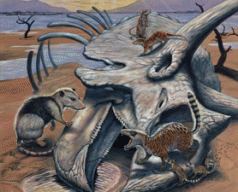
The tiny mammals survived the demise of the dinosaurs to inherit the Earth and gain the ability to build the means to survive the next mountain from space. That another giant asteroid will arrive to kiss this planet is a dead certainty and if humanity has not been smart enough to prepare for it, how far ahead of the dinosaurs are we?
Should an economic downturn lead to our losing the cutting edge of space technology, we may find ourselves trapped on Earth and when a future generation looks up to see the space mountain’s arrival, they may well curse the dust that we had been made of, for failing to build for survival.
When a society can identify a threat, but conveniently ignores it, pushing the danger onto a future generation, is this a form of collective suicide, especially as the threat could arrive unexpectedly in this generation?
Asteroids do bump into each other, sending both into new orbits. There are trillions of objects beyond Pluto, the source of comets, which the Sun and Jupiter draw in from time to time. In our Milky Way galaxy there are predicted to be as many free-roaming planets as there are stars and one of these dark objects could find its way into the Solar System at any time.
If we decided to lift our game and prepare for survival, the first step would be to build solar power stations in space, which would allow industry to be launched beyond Earth to make any product for Earth and future space markets. We would also be able to build orbital space settlements anywhere in the Solar System.
When the mountain arrives, we will then have a robust industrial and defensive position beyond Earth to turn the space mountain onto a new orbit, or mine it into oblivion for resources. If the object is a planet from beyond the Solar System, we will have maximised our chances of survival by building orbital space settlements beyond Earth.
Serious space development will not be cheap, but when it is appreciated that a line will be reached in progress beyond Earth where there will be no further cost to Earth, then the cost of the survival insurance policy will be met in full. This can be called the Liberty Line, beyond which all further space development will be essentially free and the return to Earth on the investment will be infinite, from across the Solar System and toward the stars.
Progress on this survival investment should have begun in the 1970s, when a transition could have been made from a house-of-cards carbon economy, to one based on stellar energy with a strong economic foundation that would last as long as the Sun shines. Delay has proven dangerous, with the release of so much fossil carbon into the atmosphere, that it now presents a threat to the Earth and a danger to the stability of human society.
Because we have used fossil fuel too long, we now need more than 1.5 Earths to keep our society running and this is racing toward 2 Earths by 2030 (World Wildlife Fund 2010 report). This bubble economy is being blown ever larger by our use of fossil fuel and the point in time will come when it bursts; and when it does, human society on Earth will be in a terrible mess.
Some believe that this crisis could arrive within 5 years as a consequence of peak oil. Others suggest ten years, when the Earth change crisis starts to boot in. Should we manage to keep our society running longer, we will face the consequences of Earth changes that James Hansen tells us could become a runaway greenhouse effect, turning this planet into a second Venus, where the rocks glow in the heat. If this happens, no life forms may survive on this planet, as all water turns to vapour and is blown away into space (p.223, the Venus syndrome, ‘Storms of My Grandchildren’ by James Hansen, the world’s foremost climate scientist and head of NASA’s Goddard Institute for Space Studies).
The crisis for life on Earth is intensified by the detail that our star is now 25 percent hotter than at the dawn of life 3.5 billion years ago. Despite this rise in heat, our planet’s life-support systems have diligently kept the temperature down, but with the pressure that we are putting on the Earth, James Lovelock warns that Gaia could snap and make a sudden shift toward a permanently hotter state (p.108 ‘The Vanishing Face of Gaia’).
Should humanity hear the warning calls for survival and decide that it is high time to act while we still have a chance to be effective, the momentum of building a survival insurance policy beyond Earth will invigorate the global economy with a new spirit, determined to survive and succeed. We will also be in a position to solve any problem on Earth, win back a safe Earth, build a sustainable human presence on Earth and send poverty into history.
If we wait too long, the gathering crisis may overwhelm us, especially with our house-of-cards economy built on a totally unsustainable energy source. If we act on survival, we will buy a lot more time to succeed, as human communities will see how to solve any problem on Earth, as we reach to an absolutely amazing future among the stars.
And we will be ready when that mountain from space arrives to kiss the Earth.
The Silver Bullet Men
Chris Harries 1 Aug 2011 Tasmanian Times
http://oldtt.pixelkey.biz/index.php?/weblog/article/the-silver-bullet-men-jimbooooo/
Re: 31 Neil Smith
With access to unlimited stellar energy from the Sun via solar power stations in space, it will be possible to deal with the carbon problem completely, by mining carbon from the air as a resource and releasing all that locked up oxygen back into the atmosphere.
Before progressing too far with a plan for space based solar power and any potential patents, examine the work that has been done. Research documents dating from 1968 can be found with NASA and the National Space Society (America). The Space Studies Institute, founded by Gerard K. O’Neill, may also hold documents prepared by his team when they were exploring how stellar energy could be used for industry in space and also brought to Earth to help keep the Earth safe.
Concerning the building of solar power stations in space to provide energy for Earth, physics professor Gerard K. O’Neill wrote, “If this development comes to pass, we will find ourselves here on Earth with a clean energy source, and we will further improve our environment by saving, each year, over a billion tons of fossil fuels,” (p.162, ‘The High Frontier’ 1977).
Recent proposals out of America, using more refined technology, has proposed a system of low Earth orbit satellites, but I suspect that this would be fraught with risk because of space junk at this level and also the detail that ground-based solar energy collection may be able to supply Earth energy needs.
My preferred location for space based solar power stations would be at a geosynchronous orbit and beyond. The energy may be primarily used for the emergency period, to get carbon out of the air and enable us to build through any dangerous Earth changes that the atmospheric overdose of carbon brings on, especially if algal blooms in dying oceans begin releasing toxic hydrogen sulphide gas that can kill life on land and destroy the ozone layer, forcing us to live on Earth more as if we were living in space, if we wish to survive.
We may need to build protected environments to preserve life, arks that could be opened to release life back onto the Earth, once the Earth has been made safe again using stellar energy. If we act swiftly on this problem, we may avoid the worst that is now predicted (the Venus syndrome, p.223, ‘Storms of My Grandchildren’ by James Hansen, head of NASA’s Goddard Institute for Space Studies and the first scientists to warn the world about climate change).
With direct access to stellar energy in space, we would be able to build a sustainable human presence on Earth and then Earth-based energy systems could keep the system running. Space based stellar energy collection would be there as a back-up for any emergency situation.
The real future for solar power stations in space will be for space industry and the building and running of orbital space settlements, which would provide an Earth gravity via rotation. In this way we can shift from the current carbon fuel based house-of-cards economy, to a Solar System-wide solar economy with a strong economic foundation that will last as long as the Sun shines.
We would then be in a position to deal with any asteroid that threatens the Earth and human survival, by moving it into a new orbit, or mining it into oblivion for resources.
In this future, which we could have already been in if we hadn’t been so keen on wars like in Vietnam and Iraq and nuclear weapons, we would by now have been using stellar energy to power laser beams to send swarms of tiny robot explorers fitted with solar sails to the stars, dispatched to a high velocity on journeys lasting decades, not centuries.
In part reflecting on Britain’s efforts during World War II, James Lovelock wrote, “We are deeply impressed with the power of our weapons, yet they are puny compared with the most powerful weapon of all: creative intelligence.” (p,157, ‘The Vanishing Face of Gaia’ 2009).
Kim Peart
Illustration by Mark Hallett from here:
http://news.discovery.com/animals/dinosaur-last-survivor-extinction-triceratops-110712.html
SPACESHIP EARTH DID NOT COME WITH LIFEBOATS – WE MUST BUILD THEM
*Pic: Illustration by Mark Hallett: Surviving the next monster asteroid demands a confident survival presence in space and current Earth changes give us maybe 10 years to act.











