

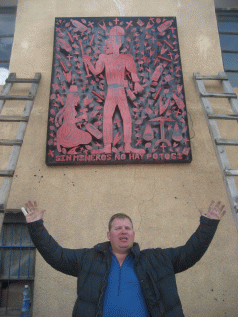
Outsider artist Bobby-z recently completed a sculpture (his first) in Bolivia commemorating of the many living and dead miners of the Potosi mines there. These mines are some of the most dangerous in the Western hemisphere, with hundreds of fatalities and injuries every year. Embracing the spirit of Outsider Art and drawing some inspiration from the Folk Art of the region, Bobby-Z created a sculpture, uncommissioned, with the help of some of the miners and gave it directly to the people, rather than displaying it in a gallery or public place. The journey to do so was difficult, with only mining tools available and the authorities of the mines opposed to Bobby-Z´s work.
My name is Jonathan Madge, I am a freelance journalist with over 8 years experience writing for magazines, newspapers, online and radio productions. A substantial body of my work has been in the field of art criticism and reporting. I was lucky enough to encounter Bobby-Z early in this recently completed project and so have access to the entire story, including photographs.
This story is one of Outsider Art at its purest, of an artist battling with some of the worst of real life and producing a piece that stands out as unique, in a unique loction (it is displayed at the entrance to the mines) and with a unique story. It is also a story which depicts the contribution of a pioneering Tasmanian to the world.
“Without the miners, there is no Potosi” … they are the words at the bottom of the sculpture nailed to the wall of the Diego Huallpa Mining Museum in Potosi, Bolivia. The sculpture is the work of Tasmanian painter and sculptor Bobby-z Lambert. It is his gift to the miners of Potosi.
Made of steel pieces welded to a frame, it depicts a miner and a Palliri (female mine worker) surrounded by the things that fill their lives. Sticks of dynamite, packets of cigarettes and coca leaves, all cut by hand or with the most basic tools from plate steel, surround the pair. Perhaps most true to the everyday dangers the miners face is a pair of scales, weighing the silver they all hope to find against a pair of dust-ruined lungs. It’s a powerful and uncompromising image to be hanging from the wall of the museum, which is also the main entrance to the mines.
‘Powerful and uncompromising’ are two of the words that best describe how Lambert came to create this sculpture. His back catalogue of work deals, for the most part, with Australian and South-East Asian issues. Always unflinchingly honest, he has shown some of the worst sides of the culture and history of these regions, as well as some of the best.
The journey from Tasmania to Potosi was not the usual one for an artist. Lambert was not commissioned to create the piece, instead he felt drawn to the place and the story of Potosi, and compelled to give something back. Throughout its design and construction, the artist was adamant that it would be something specifically for the miners. This position more than once placed Lambert in confrontation with the mine bosses.
On a trip to Chile to gather inspiration, Bobby-z had found himself languishing in the artist’s equivalent of writer’s block. None of the ideas he had seemed right for that moment. In fact, the only thing which took a hold on his imagination was the memory of an old mine, across the border in Bolivia.
The more he researched the mine, the greater the pull it had on him. A former rock driller, Bobby-z knew that there was a story in the mountain which had funded the Spanish empire for over three hundred years. It was to be a story he was perfectly placed to tell.
He describes an ambivalence that invaded his whole body, when he arrived in Potosi, “I felt the dead wanting to be remembered there”. The presence of death was so strong that the artist almost turned on his heels and caught the first bus back to Chile. But at odds with the death that filled the town he also felt something friendly and welcoming.
This emotional paradox describes much of what Potosi is. A city very proud of its history (granted the status of World Cultural Heritage Site by UNESCO) its pride is in a past that saw a genocide of immense proportions. Hundreds of thousands of the indigenous inhabitants of this area of South America were systematically worked to death extracting the silver that once filled the mountain Potosi is built on.
To this day, the miners still toil in near-medieval conditions. Many of them drill by hand into rocks rich with asbestos. Silicosis, a disease that turns the lungs to stone, is a common cause of death here. Lack of training sees smoking miners handling dynamite in a way that trusts their survival entirely to luck.
Now the Spanish have left, the multi-coloured peak is mined for zinc, lead, tin and a dozen other trace metals ignored by the colonists. Yet the miners all hold out hope of discovering a vein of silver glistening in the dark. The metal which almost killed Potosi is still the hope of those who work deep in its tunnels.
When he began working on the sculpture, Lambert enlisted the help of some local miners. Over the weeks that followed, he had to teach them how to use some of the most basic tools. When one of the men began to weld without wearing a mask, the artist bought new welding equipment for the group. But even after explaining how crucial it was, and how damaging not using it would be to the men’s eye, Bobby-z watched the men smilingly weld without it.
This is not the image of a different culture doing things a different way. Nor is it that of arrogant Bolivians thinking they know better. The smiling welders, burning away at their eyes with every blast of the torch, are an example of the lack of education about its dangers that runs richer than any ore in the mines.
Such ignorance is kept alive by the mine owners and operators. Many of them are miners who have found a seam of silver, or some other precious metal, allowing them to buy themselves out of the mines. Once above ground, the owners are hard to convince to improve conditions, air and water pumps have to be fought for, and those fights are rarely won.
The dangers of mining in Potosi, where 40 is considered a good life, have existed for so many years that they are just considered a part of life. The risks of death or mutilation are shrugged off like those of car accidents in more privileged countries. When everyone knows someone who has lost a limb in the mines, it becomes hard to think of such things as avoidable.
Bobby-z’s insistence that the sculpture was to be for all the miners gained him few favours with those in charge. On the day of his work’s unveiling the truck offered to transport the piece was withdrawn and the men supposed to mount it were reallocated. Two hours after it was intended to be unveiled, it lay on a rock in the dusty sun.
Happily, that rock was not the final resting place of the work that took six weeks and an immeasurable amount of personal sacrifice to produce. True to the spirit of the piece, it was a team of miners who carried it down the mountain by hand and fixed it to the wall where it now proudly hangs.
The work of these miners, who overcame the fierce rivalry that is encouraged between the different mines, was a testament to what Bobby-z wanted the sculpture to stand for. All of the miners are part of a sad but proud history. So often, even in Potosi, this is overlooked. The men who carried that solid steel frame down a mountain in the blistering midday sun did their bit to make sure it will not be overlooked in the future.
Speaking with me, Lambert said, “the whole thing was a struggle to complete right to the last and perhaps this is fitting as representing the miners of this place should not be easy”.
Over the weeks he took to make it, I spoke to Bobby-z many times about what the sculpture means. The answer he always returned to doesn’t just perfectly describe the piece that now hangs at the entrance to the Potosi mines, it also describes the city itself.
“It is important to understand this sculpture is as much for the dead as for the living. It marks the sacrifice of both.”
Bobby-z Lambert is a Tasmanian outsider artist, whose work can be found online at:
http://www.bobby-z.com/
and
http://www.despard-gallery.com.au/artists/lambert/text.html
He is featured in ABC Collectors specialist Adrian Franklin’s new book Collecting the 20th Century: Page 225 is devoted to a detail of his painting, The Brink, with the words: Bobby-z Lambert The Brink detail (undated). This is one of the most exciting and collectable artists i know. Fabulous, confronting, scary, but always in close dialogue with twentieth-century life.
He was also featured in a Mercury story which detailed his brief marooned-in-Chile plight after the recent earthquake.
Download: bobbyzMER04MAR014.pdf


Bobby-z with Jonathan Madge (centre and left) and miner mates …











