IT’S late morning and we’re snorkelling in bright, warm water among a sea of multicoloured fish and half a dozen honu green sea turtles, some of the most laid-back animals I’ve ever encountered.
That’s hardly surprising because we’re on Hawaii’s Kohala Coast, billed as a tropical paradise and one of the last refuges for this extremely graceful — in the water anyway — and unfortunately endangered creature.
What is surprising is where we are and what we’re doing just six or seven hours later. We’re at well over 4000 metres, sporting Arctic parkas in temperatures near zero and watching the sun set amid one of the world’s greatest accumulations of astronomical equipment.
And we haven’t boarded a plane in the mean time. It’s just that Hawaii’s Big Island* is being just that and also proving to be much more diverse than we’d ever imagined.
It offers examples of most of the world’s defined climatic zones. We’d already experienced the active lava fields of the island’s south, the humid coffee plantations of the south-west, the tropical monsoon country around its east-coast capital Hilo (think swaying palms, the smell of pineapples and coconuts in a 19th-century port, and James A Michener), and the aridity of the Kohala Coast in the north-west.
Now Greg Brown, of Hawaii Forest & Trail tour company, is taking us on the ascent to the peri-glacial fields atop Mauna Kea, slowly wending his four-wheel-drive bus through the zone where breathing can be affected — “you don’t need a few glasses of wine to feel a bit piddly up here, so take it easy when you get out.”
The views, too, are breath-taking, whether they be of the surrounding countryside, or, later, of the fields of cloud you have to pass through.
It is a massive mountain. Indeed, in terms of mass, it’s rated the world’s biggest mountain and, if you measured its height from its real base on the bottom of the Pacific Ocean rather than from the conventional sea level, it would top Mount Everest by a fair whack.
For the indigenous Polynesian Hawaiians, whose ancestors migrated there at least a thousand years ago from Tahiti and/or the Marquesas, Mauna Kea is a most sacred site, equivalent to something such as Ularu. Its very top is taboo to all but the selected few, yet a few hundred metres lower, facing some of the world’s clearest night skies, are an andromeda of astronomers.
Leaders in the field from the United States, Britain, France, Japan … the list goes on … point their huge telescopes from here. The site has just beaten Chile for the contract to install the largest optical telescope ever built, and the locals are mighty proud about that.
Greg, who has been a tour guide for Hawaii Forest & Trail for many years, has provided us with wonderful commentary about the island’s sociology, geography and geology right from pick-up and through a hearty meal.
But it’s when he pulls the telescope from the rear of the bus and starts showing us the stars and the planets that he really gets into his own territory. This is something he loves and you know it’s hard for him to abandon the stories and begin the drive back down the mountain.
On the way back down, he points to the dull, orange street lights in the coastal settlements. They’re designed, apparently, to minimise the effect on observations made more than four kilometres above.
The next morning, we’re back snorkelling with the vibrantly coloured tropical fish and those wonderful turtles, who in some ways prove even more compelling and more magnificent than Mauna Kea itself.
Drifting up from a depth of three or four metres, about a hundred metres offshore at the Fairmont Orchid Resort, they seem to make genuine eyeball-to-eyeball contact, their eyes bobbing above the surface whenever yours do.
We get a chance to see the turtles again a while later, this time from the surface in an outrigger canoe which is provided as a complimentary bonus on the Fairmont’s private beach.
Overall, the Fairmont Orchid is a near-faultless resort, with levels of facilities, both in-room and public, that are extremely high. Service is at your beck and call.
But it is in an area that has pluses and minuses.
The pluses include all the usual — and more— trappings of a resort. There are elegant rooms, fine gardens and swimming pools, pristine beaches — with white sand, well formed surf and absolutely magnificent snorkelling — and ready access to a range of historic National Parks and, of course to Mauna Kea.
The minuses, I guess, come from the fact that the Kohala Coast is essentially a string of resorts, with shops grouped together in malls similar to those you’d find in any large Australian city. You can’t walk out of the Fairmont, or anywhere else on Kohala, to a beachside esplanade of shops and restaurants, stroll along a promenade, watch the passing parade and select your choice of dining from a range of interesting options.
It’s just not like that, but at the same time it’s very, very good, and you should certainly consider upgrading yourself to a room on the Fairmont’s Gold Floor. It does cost a bit more, but the bonuses include free parking, free internet access, free breakfast, free evening snacks and daylong access to a lounge with business facilities and a help desk that will readily and efficiently make restaurant and travel bookings, check your flights, etc.
And that’s something that really does help take the effort out of travelling.
*The Big Island is about a 40-minute flight south-east of Honolulu. Its real name is Hawaii, but because the whole archipelago has adopted that name and each of the other islands has a separate name (Oahu, Maui, Kauhai, etc), the locals simply call it the Big Island.
Other musts ont he northern end of the big island
On the road north of Fairmont Orchid, make sure to stop at Pu’ukohola Heiau National Historic Site, which features one of Hawaii’s last major temples, built in the early 1790s by King Kamehameha I.
The Hawaiians love their former royalty and Kamehameha I, also known as Kamehameha the Great, holds a very special place. After dedicating the temple to his family’s war god Kuka’ilimoku, he waged war on the other tribes and succeeded in unifying, for the first time, all the islands into the Kingdom of Hawaii.
Have lunch at Bamboo Restaurant & Gallery, in Hawi, right at the northern tip of the Big Island. It’s housed in a fabulously decorated old hotel, oozes atmosphere and serves sensational traditional island fare, including its specialty chicken satay pot stickers (spicy chicken wontons). The rambling gallery is well worth half an hour.
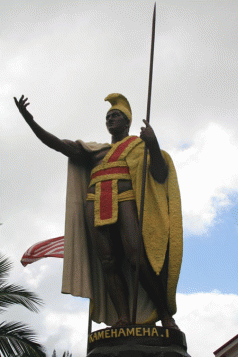
Just east of Hawi, at Kapa’au, is a massive statue of Kamehameha I, gloriously resplendent in his yellow-and-red cloak.
Drive just a bit further east to the Pololu Valley Lookout to get an idea of ruggedness of the island’s lush, rain-soaked east coast.
Visit Waimea (nothing to do with surfing’s legendary Waimea Bay, which is on the island of Oahu). The town sits right on the ridge that separates the island’s strikingly different rainfall regimes, with its eastern half getting some four or five times the rainfall of the western half. You can see the dividing line in surrounding paddocks — green on one side of the ridgeline, brown on the other.
If you go
Qantas, Hawaiian Airlines and Jetstar fly direct to Honolulu from Sydney. The flight is about nine-and-a-half hours. Shop around and you should be able to get there for less than $1000 return.
Hawaiian Airlines and a bevy of smaller carriers do the inter-island runs on virtually a commuter basis. Book ahead and you should be able to fly from Honolulu to the Big Island (either Kona or Hilo) for about $50 each way.
You really do need to rent a car to comfortably visit the Big Island. Rental rates are reasonable and you should be able to get something like a Chrysler PT Cruiser (they’re everywhere on the Big Island) for about $50-60 per day all up, depending on season. Australian operator DriveAway Holidays is a good starting point.
Drinks-wise, the local Kona beers are good, the macadamia-based Kahana Royale excellent. Beware the classic rum-based mai tais … they’re delicious but potentially deadly.
Unlike in Australia, where GST is included in the shelf price, Hawaii’s State tax of some 4 per cent isn’t, so always be prepared to throw the extra cents on the counter. Tipping is not just expected, it’s essential in some places — 15 per cent, for instance, is the going rate in restaurants.
Pictures: SANDRA BURN WHITE.
DISCLOSURE: John Rozentals and Sandra Burn White received discounted accommodation at Fairmont Orchid Resort, and were guests of Hawaii Forest & Trail on the Mauna Kea Summit Tour.
CONTACTS
Fairmont Orchid: www.fairmont.com/orchid
Hawaii Forest & Trail: www.hawaii-forest.com
Big Island: www.bigisland.org
Hawaii: www.gohawaii.com
National Parks: www.nps.gov
Bamboo Restaurant: www.bamboorestaurant.info
DriveAway Holidays: www.driveaway.com.au


Captions:
mauna 1 & 2: A sentinal above the clouds … one of the many observatories on top of Mauna Kea.
fairmont pix: Fairmont Orchid … A near-faultless resort, with levels of facilities, both in-room and public, that are extremely high. One, obviously, is of the Gold Floor lounge.
The statue of King Kamehameha I at Kapa’au.
Pololu Valley Lookout.
Bamboo Restaurant … good fun and exceptional food.