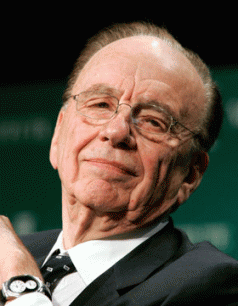
Rupert Murdoch is due in London (this) week, just as his company’s attempts to close down the phone hacking crisis are in tatters.
Murdoch tried to keep phone hacking cases out of the courts and out of the public eye through confidential settlements with the likes of football boss Gordon Taylor and PR guru Max Clifford. When that failed, the publisher of the News of the World insisted that phone hacking was the action of a single “rogue reporter” – jailed former royal editor Clive Goodman – and its executives chose to lash out.
Rebekah Brooks – the former editor of the News of the World, the Sun and now chief executive of News International, News Corp’s UK arm – blamed this newspaper. When the Guardian reported there were potentially thousands of victims of phone hacking, her message was clear: “The Guardian coverage, we believe, has substantially and likely deliberately misled the British public.”
Now, after Andy Coulson’s departure from David Cameron’s side (HERE: Secret tapes, Andy Coulson’s exit and the riddle of a story that won’t go away), it is clear both strategies have failed, just as News Corp tries to win approval for his £8bn takeover of BSkyB. With News Corp mired in crisis, Murdoch’s arrival is timely – because in the end no decision of significance can be taken without him at the company he has built over half a century.
News Corp officials say they knew nothing of Coulson’s announcement, but even with his departure, senior executives in London know it would be naive to hope his resignation will draw a line under the phone hacking affair.
The company well appreciates that the drip-drip of revelation will only continue as lawsuits brought against the newspaper by actor Sienna Miller, football agent Sky Andrew and publicist Nicola Phillips, and many others, develop. Each case moves slowly, an inching forward of witness statements and court hearings that will last months if not years.
Brooks had been trying, behind the scenes, to settle at least some of the civil claims – involved, lawyers say, in proposing six figure payouts. Recently that strategy has been abandoned in favour of allowing claimants to put evidence into the public domain, and if that amounts to material implicating one of its journalists, taking action against staff.
Allegations loom against reporters, questions remain for former editors like Coulson, while Les Hinton, executive chairman for 12 years until 2007, seemed to be confident hacking was not widespread. Hinton told MPs last year: “There was never any evidence delivered to me that suggested that the conduct of Clive Goodman spread beyond him.”
Critical evidence is being extracted from the Metropolitan police. The Met is sitting on notebooks, call records and other information seized from Glenn Mulcaire, the private investigator employed by the News of the World in 2006, as part of the inquiry into phone hacking at Buckingham Palace. Each of the celebrities who sue base their claims on their names, or numbers, appearing in Mulcaire’s notes.
It was Miller’s case, with a high court filing in December, that triggered the suspension of Ian Edmondson, the News of the World’s assistant editor (news). Her lawyers noted that Mulcaire had a habit of writing the first name of the person who instructed him in the top left corner of his notes. On Miller’s notes it was Ian. It is an example of the kind of revelations that are likely still to come.
Each time evidence from the Mulcaire files becomes available, it is sent not just to the celebrity litigant, but to News Corp’s legal team. If Murdoch wishes to view the files, he can do so. What conclusion he will draw is what will drive how his company reacts to the controversy.
Tuesday, Roy Greenslade: The list of claimants against the News of the World is likely to grow longer in the wake of Andy Coulson’s resignation
The dark arts of the press are being exposed to public view
Just imagine the scene inside Wapping the moment the news broke on Friday morning that the prime minister’s director of communications, Andy Coulson, had decided to step down. News International’s senior executives were aghast. This was the very thing they did not want to hear for two obvious reasons.
First, it confirmed that the company’s long-held “single rogue reporter” strategy to protect itself and Coulson from continuing questions about the News of the World phone-hacking scandal had indeed collapsed.
Second, the publisher lost a crucial political ally within the heart of the British government at this most sensitive of times with the fate of Rupert Murdoch’s bid for BSkyB in the balance.
The drip-drip-drip of revelations from legal documents had finally created the pressure that Coulson, despite the former News of the World editor’s protestations of innocence, could no longer resist.
The key disclosure was the suspension of the News of the World’s assistant editor (news), Ian Edmondson. Though it happened before Christmas, it did not become known publicly until 5 January.
News International took the action after becoming aware of court documents which allegedly show that Edmondson had asked private investigator Glenn Mulcaire to hack into phones belonging to actor Sienna Miller and her staff in 2005. Mulcaire was jailed alongside the paper’s royal editor, Clive Goodman, in January 2007 for intercepting voicemail messages from members of the royal household.
The pressure increased last week when Mulcaire submitted a statement to the high court confirming that Edmondson asked him to hack into voicemail messages left on a mobile phone belonging to Sky Andrew, a football agent. Andrew, like Miller, is suing the paper for breach of privacy.
Ever since Coulson resigned as NoW editor that month – four years ago this week – he and News International have maintained that Goodman was a “rogue reporter”. Nobody else on the paper took part in hacking, they said, and Coulson was unaware of any such activity.
At the time, this didn’t sound plausible to me. As a tabloid editor and senior tabloid executive, it was my business to know the provenance of stories. I spent more than 20 years on popular papers and every editor I worked for was aware of what was happening in their newsrooms.
During my tenure at the Sun, I knew how the News of the World – just a floor below us in Bouverie Street and then Wapping – operated. Executives questioned reporters closely about how they obtained their stories. It was inconceivable to me that executives would simply accept editorial copy without bothering to ask staff how they came by it.
The scepticism about the “rogue reporter” defence was widespread. The majority of the journalistic community didn’t believe it. The judge who sent Goodman and Mulcaire to jail thought it unlikely. MPs on the Commons culture, media and sport select committee turned up their noses too.
…
But the phone-hacking scandal was never really a political story. It is about journalistic ethics, in particular at the News of the World, and, in general, about the rest of the national press. It is helping to shine a light on Fleet Street’s dark arts.
It also hinges on the questionable relationship between the Met and the paper. There is a further political aspect to consider – the relationship between News International’s ultimate owner, Rupert Murdoch, and No 10. How will that fare in future?
There are still reasons for both David Cameron and Murdoch to cosy up to each other. The former wants the Sun on side and the latter wishes to benefit from regulatory liberalisation, not least over his desire to avoid a Competition Commission inquiry into his attempt to acquire full control of BSkyB.
…
It has been noticeable over the years that several newspapers have largely ignored the revelations about the News of the World’s activities. In some cases, that was because of guilty consciences. In others, it was due to the disgraceful, informal, mutual “agreements” between certain owners and senior managements that ensure nothing is published that embarrasses either side, a pernicious form of censorship.
That, of course, is a form of the dark arts all by itself. And the centre of that web, which has led to the virtual elimination of media monitoring by every national daily – except for the Guardian, the Independent and the Financial Times – is none other than News International itself.
While newspapers cry out for greater transparency in politics and in business – indeed, in every sphere – it is ironic that they are so opaque in their own dealings.