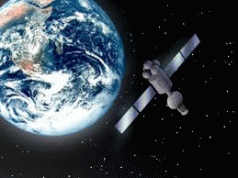
In early 2007 China hit one of its own satellites in space with a missile. It was a neat bit of target practice and also a shot across the bow of future progress beyond Earth. It appeared to say, “Start a war with China and watch your satellites disappear.” Is this the future?
When China blew it’s satellite a great deal of space junk was spread through space, making it tougher for other nations to dodge the debris. Should conflict lead to many satellites being blown up, the resulting debris cloud could trap humanity on Earth for some time, making space too risky for commercial satellites and manned spaceflight. The loss of communications satellites could plunge global commerce into a new Dark Age, comparable to the 1950s for many services that have come to rely on satellites.
Looking forward to the prospect of human settlement in space, such as with orbital settlements, we are looking at structures that are essentially bubbles in the vacuum of space, all too easily burst from within or without by conflict and or terrorism. Space settlement could come to a grinding halt if one or more orbital space settlement were lost in this way. What, then, would be the best way to achieve security in space?
Humongous sums can be spent on defence and security, but all aggressive precautions would offer no comfort after the event of a catastrophic loss. Is there another way to achieve security in space?
There could be, when it is considered that a line would one day be reached in space development where there would be no further cost to Earth, where all subsequent space development would be essentially free and the return on the investment would be infinite. I call this the Liberty Line.
When it was accepted that the commitment to space development would connect to the Liberty Line as a primary objective, a date might even be identified for this to happen, which would generate a form of futures development market. With a clear objective for human futures beyond Earth, the time distance would begin to shrink rapidly as space development accelerated. Many benefits would be realised early on, such as with an increase in employment opportunities that are both exciting and creative. A whole new global economy would begin to take shape that put a new bounce of hope in the step of humanity.
(This new global economy might also be described as the Solar economy, where ‘Solar’ refers to the Solar System-wide economy that would be emerging, including on Earth.)
The last thing that the emerging Solar economy would want now is conflict and or terrorism to wreck the future and trap humanity on Earth.
There is an alternative way of building security? Conflict is often driven by inequity, which can be a humiliating experience for any individual. A young man in Tunisia was so humiliated at being blocked from working, that late last year he set himself on fire and died. This act caused a public reaction that saw the dictatorial governments in Tunisia and Egypt forced out by a popular and largely peaceful uprising of ordinary people who had had enough. This demonstrated to the World how change can happen and alternative pathways into the future found.
With a clear view to the Liberty Line, it would be possible to consider a whole new way of dealing with our problems on Earth. We would not have to wait to reach the Liberty Line to realise the benefits, as these would flow early on when working toward a known future that will be achieved.
With a view to infinite returns on the investment from beyond the Liberty Line, it would be possible to begin a whole new era in human progress, by being physically able to offer a healthy life with unlimited creative opportunities for all Earth’s children, on Earth and among the stars. We would be in a physical position to send poverty into history, permanently, by designing a Solar society and economy that simply did not include poverty, homelessness or starvation and a proper level of health care made available for the citizens of all nations.
A vision for space that included a healthy life for all Earth’s children would have the potential to lead to peace on Earth and deliver security in space. All parents have children and all parents want the best for their children. With a view to the Liberty Line, we would be in a position to begin offering a better future for all and this may be the best and most efficient way to win the hearts and minds of the people of Earth to the future that is being created.
Winning good-will with a neighbour is the best, cheapest and most efficient way to achieve peace and security, locally and globally.
With a view to the Liberty Line and the bounty generated by Solar development, it would be possible to establish a Solar Trust Fund for each child born, to ensure that they do receive proper nutrition, health care, accommodation and education. A happy and healthy child with a positive view of an exciting future will be less inclined to march off to war or become a terrorist.
By achieving peace on Earth, we can maximise security in space and there may never be a problem in space when there is peace on Earth. Instead of looking over our shoulders for the assassin, we will be liberated from fear and emboldened to build a mature and cultured star-faring society. As we reach out across the Solar System, we will be in a position to deal with any problem on Earth. Should we find that a mountainous asteroid in space is on a collision course with the home planet, with a robust industrial presence in the Solar System we may simply mine that mountain into oblivion for the resources.
As we gaze down the multiple barrels of catastrophe on Earth, such as being unsustainable, climate change, sea level rise, food shortages and peak oil, by expanding beyond Earth we will be in a position to solve all problems, by having access to the unlimited energy-well of our star. With much of Earth’s industry located in space, it will be possible to have a gentler and better quality lifestyle on Earth, one that allows Nature to live and evolution to continue.
If we stubbornly cling to the Earth and fail to reach out to the stars, we are at risk of boiling in our own juices, as the world gets hotter and populations grow. In this pressure-cooker environment and with nations like China and India seeking to reach super-power status, old conflicts and causes of war will stalk us. Sustainability and environmental crisis may see millions of starving people begin to move in search of food and water, where conflicts are ignited that could all too easily slide toward the nuclear nightmare.
It is theoretically possible that we could solve all our problems on Earth alone, but this view is simplistic and ignores the geopolitical dynamics that shapes human society. If we were ever going to work all our problems out on Earth alone, we would have achieved this by now. The complete opposite is the case. It is time to wake up to the realities of our world and the future for human society beyond Earth.
Our hope for the future is to begin expanding into space and return the benefits to Earth, for the health of all Earth’s children. How might this begin? Like the people of Tunisia and Egypt, it can now be the ordinary people of the Earth who declare enough is enough and demand a new way.
If the way beyond Earth is through peace, this could happen if all the money and industry in the World devoted to arms and war were dedicated to space and peace. Then we would create a better future for all quite quickly. Will governments hold a big convention and decide to do that? Maybe they will, if enough people on Earth told them too.
Space development as the way to peace begins with individuals deciding that they have had enough of the old ways of war and conflict and begin working with others to achieve a better future. From individuals with vision could grow a movement for change that, like the events in the Middle East, could take the World by storm.
If enough people in Australia demanded that it happen, our vast resource bonanza could be used to build a better future, by investing in solar power stations in space. This would be the first step beyond Earth and toward the Liberty Line, as with power stations in space, industry beyond Earth can be launched. The unlimited energy of the Sun could also be used to desalinate any volume of ocean water and pump the liquid gold to any location. Australia could support a much larger population, with a stronger manufacturing base and also be forced to face the spectre of full employment.
Will Australia act, build partnerships with other nations for space development and begin mobilising for the high frontier? Government and industry are not looking in this direction and left to their own devices, they are not likely to any time soon. If only ten people shared this vision and worked together with determination to achieve it, this could change and change quickly. More than at any time in human history, our future is now in the hands of each individual.
If we want peace on Earth, if we wish to assure human survival, if we would like a healthy Earth, if we wish to see an end to the suffering of billions of people trapped in poverty and if we like the idea of humanity becoming a mature and cultured star-faring society, it is time to start looking for 9 other individuals who are prepared, like you, to act and start building the future.
These concepts were explored in my 2006 document ‘Creating A Solar Civilization’
http://www.tdf.it/2006/2/peart_eng.htm
Post-script:
Barney Porter wrote in an ABC News online report on 12 Nov 2009, “A United Nations report has found that poor nutrition is stunting the growth of nearly 200 million children in developing countries.” Any one of those children could have been another Einstein, but we have built a world that cripples them for life. Space development offers a way to build a new and better world, if we will find the heart to act as individuals and working together, create a Solar civilization.
http://www.abc.net.au/news/stories/2009/11/12/2740530.htm
A more recent ABC report, of 11 Jun 2011, speaks of “Over 115 million of the world’s children and young teenagers, or more than 7 per cent of the total, are engaged in dangerous and life-threatening jobs, the International Labour Organisation (ILO) says.”
http://www.abc.net.au/news/stories/2011/06/11/3241517.htm?section=justin