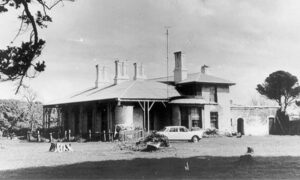
The planned entrance to the temple
After reading The Mercury’s article on ‘Temple dream doubts’ (January 20, 2012, HERE), I could not help to be disappointed at the continuing misperceptions of the planning system and the planning process that often appears in mainstream media.
The article expressed Master Wang’s concern regarding the required planning approval process for the Holy Tantra Esoteric Buddhism Group’s proposal for a temple and university for Buddhism studies at Tea Tree. The Mercury reported that the current Southern Midlands Planning Scheme would prohibit the proposal and Council had indicated that they would need to seek approval through a larger, longer, and more complex process.
While I know very little about the details of the proposal and would certainly not comment on its merits or otherwise, I was particularly concerned about the comment by the reporter that “Planning decisions suggest Master Wang faces a battle in gaining approval for the project…”.
Just because a certain proposal is not accommodated by a planning scheme does not mean that it cannot be approved or that it is unlikely to be approved.
The planning system provides for various alternative planning approval processes to accommodate these unique forms of use and development. This is no doubt, what Southern Midlands Council is referring to. These include combined amendment and development applications (Section 43A application), Projects of Regional Significance and Projects of State Significance. The need to consider a development in accordance with these processes should not be considered a reflection of its merits or otherwise or as justification for its non-consideration.
Putting aside the process for Projects of State Significance (because of the significant state wide impacts that such Projects generate) and Projects of Regional Significance (as there is yet to be a Project of Regional Significance and therefore the process is untested), the statistics for Section 32 and Section 43A applications do not support The Mercury’s concerns about facing an uphill battle. In the 2009/10 financial year there were forty one (41) Section 43A applications and only eleven (11) applications were refused outright. In the last financial year (2010/11) there was a total of twenty seven (27) with only five (5) refused outright (Tasmanian Planning Commission Annual Report 2010-2011).
If the planning system is to operate more efficiently it is important that we recognise that planning schemes are drafted to accommodate the day to day applications for use and development and the generalities of land use patterns.
Unique or unexpected forms of use and development are very hard to accommodate in standard planning scheme provisions (i.e. the zones). They are often strongly market driven, their location is difficult to predict, or they represent a new form of development or economic activity to an area that was not highlighted in any predictive analysis, or a combination of any of these.
If planning schemes are written to accommodate these more complex and rare proposal, what we potentially end up with is more complex schemes which then make the day to day applications more difficult to process quickly and smoothly.
This is even recognised by the State in the new updated Planning Scheme Template for Tasmania (Planning Directive No. 1). This directive provides for the insertion of ‘Specific Area Plans’ that allow Planning Authorities to accommodate very specific desired outcomes that may not be generally consistent with the surrounding land use or development pattern(s) picked up through the zoning.
Of course I am not going to say that we don’t need to improve and update planning schemes or the planning system. I believe that we do, even though fundamental principles and objectives of the planning system remain sound. But, in this instance it is unfair to already start pointing the finger at the planning system preventing development, when the proposal has not been tested.
Emma Riley is currently working as a planning consultant and is Immediate Past President of the Planning Institute of Australia Tasmanian Division