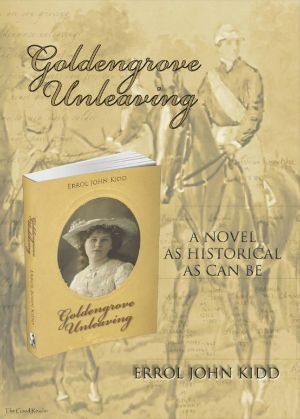
Post-modern novel reveals opulence, scandal and tragedy in the early days of Tasmania
Launch of Errol John Kidd’s novel Goldengrove Unleaving by award-winning fantasy writer, Tansy Rayner Roberts.
2 pm on Sunday, 5 February 2012
Fullers Bookshop, 131 Collins Street, Hobart.
RSVP required, email: [email protected]
30 January 2012, Hobart—Goldengrove Unleaving takes a pioneering Tasmanian family from triumph to tragedy in three generations.
It is literary fiction, post-modern in approach—yet scrupulously accurate in adhering to the known facts.
Writer Errol John Kidd, a well-regarded Tasmanian poet, says the book is about his own family history, but doesn’t gloss over difficult truths, including illegitimacy, hints of violence and even incest.
“The story as written, as far as I could discover, is an accurate account.
“Certainly the inner lives of the characters are based in imagination, but I have not invented or changed any of the facts that I discovered in my research.”
In this regard, Goldengrove Unleaving falls into the tradition of historical narrative genre novels, such as Ragtime and Cold Mountain.
It may even be said to exist within the realm of what Mark R. McCulloch has termed the ‘documentary novel.’
Goldgrove Unleaving, like the novels of W.G. Sebald, can be described as “part documentary, part travelogue, part dream sequence, part history, part memoir,
part photo album, and part cultural-historical fantasy.” (Blurring the Boundaries: History, Memory and Imagination in the Works of W G Sebald by Diane Molloy).
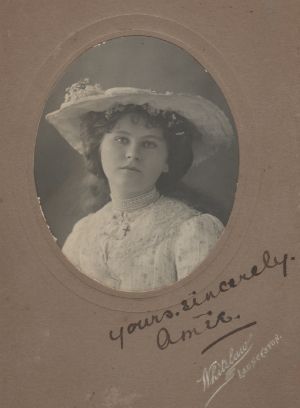
Told from the perspective of the beautiful young Aimee Krushka, heir to a tin-mining fortune in the north-eastern town of Ringarooma (then Krushka Town), the book follows the fortunes of her family over decades.
The patriarch, Christian Krushka, arrived penniless from Prussia with his wife and five children and settled in the North-East of the state. The family struggled, until the three brothers discovered tin and became overnight millionaires. A town was created in the area, and named in honour of its most influential residents.
Christopher Krushka, the plucky youngest son whose adventurous spirit spurred on the others, married Alice Fry, a distant heir of the chocolate family. The family became known for throwing lavish parties and for the owning of racehorses in Melbourne (including the champion Amadeus).
Then, in the early years of the 20th century in the wake of the 1890s Depression, things took a turn for the worse. The family was financially ruined, the town inexplicably renamed Ringarooma (anti-German sentiment may have played a part), and the Krushkas forced to adjust to a modest lifestyle.
A melancholic thread running through the story is the early death of Aimee Krushka. She was a girl who seemingly had it all—intelligence, charm, beauty and wealth—and yet, at the age of 27 died, unmarried and under mysterious circumstances.
The fate of Aimee becomes a metaphor for the fate of the family itself. Where did it all go wrong for this clan of rebels and iconoclasts?
The author, Errol John Kidd, is the great grandson of Christopher Krushka and the grand-nephew of Aimee. He grew up in Ringarooma in the 1940s and 50s, hearing stories of the family’s glory days.
The book is unusual in that it is illustrated throughout with uncaptioned colour and black and white photographs. Many of the images are from Kidd’s personal collection.
Kidd has written Goldengrove Unleaving as an ode to the times gone by, to people and events that will be forever mysterious, but that affect the present in untold ways.
As William Faulkner famously remarked, “The past isn’t dead. It isn’t even past.”
Errol John Kidd