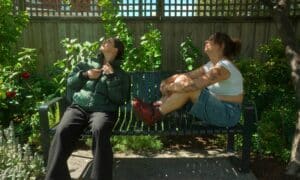
“Daniel returns to his rural Tasmanian hometown to help his mother with her real estate business. To his surprise, his best friend Emma turns up on his doorstep on the run from her marriage.”
Thus began the first series of the ABC-TV series Rosehaven, according to a blurb on iView (where all episodes of the show are available to view online, at least until 6 September).
Having just completed its fourth series for a total of 32 episodes now, the show has had a fair chance to say whatever it wanted to say about Tasmania and life on the island.
To be frank, it’s said very little.
The Emma (Celia Pacquola)-Danny (Luke McGregor) show looms large, obscuring almost all other themes. The dynamic between a classic introvert male paired with manic pixie (metaphorically!) dream girl is the engine of every single episode. Even the strong regular characters like Danny’s mother and owner of McCallum Real Estate, Barbara (Kris McQuade), never really get an episode to themselves.
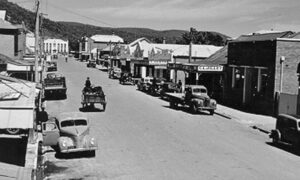
Emma and Danny float, scrap and flirt in the tiniest drop of Tasmania, depicted as the fictional town of Rosehaven. While we never hear anything of the specifics of Rosehaven, like its size or demographics or key industries, we just know that it’s small. The streets are quiet, the shopfronts are modest, the outdoor visuals are of a few streets at the most.
Moreover Rosehaven is the kind of small where Danny can’t help bumping into his former bully, nor can Emma avoid ending up on a date with one of the real estate agency’s clients. It’s proper small, where everyone in the pub – only one is shown – knows each other, and the whole town gangs up on McCallum RE when it’s heard they are trying to sell a block of land the townspeople want as a park.
This theme of bullying and (generally mild) nastiness is quite pervasive across the four series. Officers co-workers Mrs Marsh and Barbara are always cold to Danny and Emma, regardless of what is going on. Recent episodes have featured an uncompromising landlord who is prepared to annoy a tenant to hide an electrical fault, insistent birthday well-wishers ignoring Emma’s preference for no fuss, and a dinner party attempt to make friends that ends up doing precisely the opposite. The bullying even comes full circle when Danny has to stand up for his bully against an overbearing radio station manager.
The coolness is reflected in the atmospherics. Rain and overcast skies are the common denominator, with only occasional glimpses of the sun. Those of us who live in Tasmania know full well the power and glory of the range of weather phenomena here, yet Rosehaven is 90% grey; that’s either a sop to a mainland stereotype of Tasmania that is not worth challenging, or a reality of shooting budgets and schedules.
But it’s not just weather, as pretty much all Tasmaniana is AWOL. National parks? No. Beaches? No. Cities? No. Arts and culture? Very little, save the cameo of the (fictional) Rosehaven Hop Festival in series two. Tasmanian animals? Holy heck no. While a Tasmanian devil skipping down the main street might be a paw too far, there was nothing stopping Emma befriending a pig in these circumstances in series three. An eagle swirling, a parrot flashing by, a pademelon watching from its glade? Rabbits, cats, dogs, fish, cows and probably other tame animals are referenced on screen, but nothing that hints of wild.
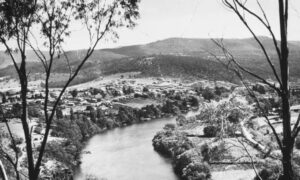
Wilderness. You’d think the can’t-sit-still Emma would be the kind of person to be gadabouting the numerous tracks and walks on offer in Tasmania, regardless of squeamishness about anything, but that doesn’t happen either. There’s not even a distant view of mountains; it’s as if any hint of ruggedness and grandeur has had to be carefully pruned from the imagery of the series. Smallness, remember.
The airbrushing doesn’t stop there. Rosehaven exists in a Tasmania with no history (other than the personal anecdotes of a few characters). There is no contemporary context of the transformation of the state from industry toward tourism, from resources toward lifestyle; in fact there are precious little indications of why anyone would want to live in Tasmania, or what they do here. There is no historical context, no convict ruins, no Aboriginal middens, no shipwrecks, no inbred political dynasties.
Rosehaven is a kind of Truman Show where Danny and Emma are the unwitting town celebrities, at whose every neurotic tick we giggle or wince, while the rest of the residents are secretly in on it. They carry on thinly-plausible lives simply designed to put the pair in the spotlight and provide them with character-building moments.
The Tasmanianness on offer is a wan pretence of something, but not much. There is a Tasmanian-shaped graphic on the emblem of the state real estate association, but in the same episode the only towns mentioned are fictional. The catchcry of series one, ‘can’t hack it on the mainland’, simply posits the island as something other, and arguably inferior, to the rest of the country. Whole episodes pass without mention of the T-word.
Meanwhile most things don’t work properly, as if this is the way Tasmania must be viewed. The doorbell of the McCallum office in series one is continually on the futz, a blackout plunges the town into chaos into series two, Emma and Danny get lost while looking for a property out of town, the local copper is a cop out, the (fictional) Green Valley Council is uncooperative, and relationships are invariably dysfunctional: Barbara McCallum doesn’t get on with her sister, Danny can’t keep it together with his fiancee and Emma can’t find anyone she wants to date more than once.
Is it all bad? Of course not. Rosehaven manages to still be somehow charming; life goes in, most of the local conflicts get resolved, and in perhaps genuine Tasmanian fashion the people manage to keep living alongside one another despite their differences. It’s a twee world, to be sure, but also quite close to the bone in its forensic obsession of the foibles of the two leads. The quirkiness is affected enough to be noticeable, and indeed mostly funny, but not so overdone to have any Tasmanian leaping off the couch in outrage.
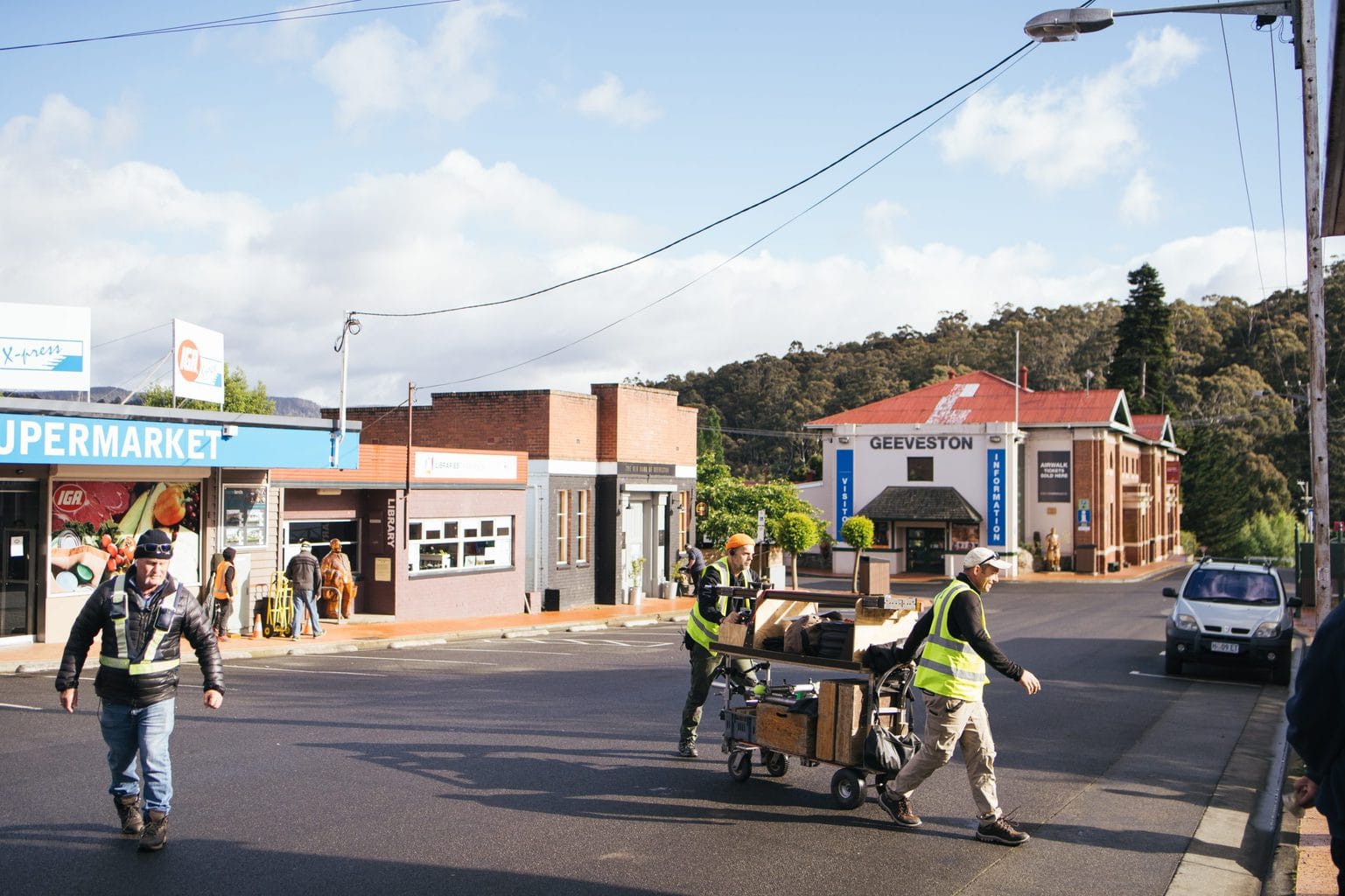
Perhaps that’s the secret of its success, at least locally: we can’t really reject the show for being un-Tasmanian when in fact it’s made very little effort to be so. We can content ourselves with the sweet glimpses of New Norfolk, Richmond, Geeveston and more, as we crave any kind of recognition and credible presence in the brutally tough overall scene of national television. We thank the ABC for providing the gift of attention, as well as useful jobs for locals both in acting – Mick Davies, John Xintavelonis and many more – and production.
But if we’re talking the quintessential Tasmanian comedy, or even drama, that makes a brave stab at defining who we are, this isn’t it.
We eagerly await its arrival.
Alan Whykes is Chief Editor of Tasmanian Times. He completed a major in Media Arts at the then MCAE, now part of the University of Melbourne. He wishes he had time to watch more television.