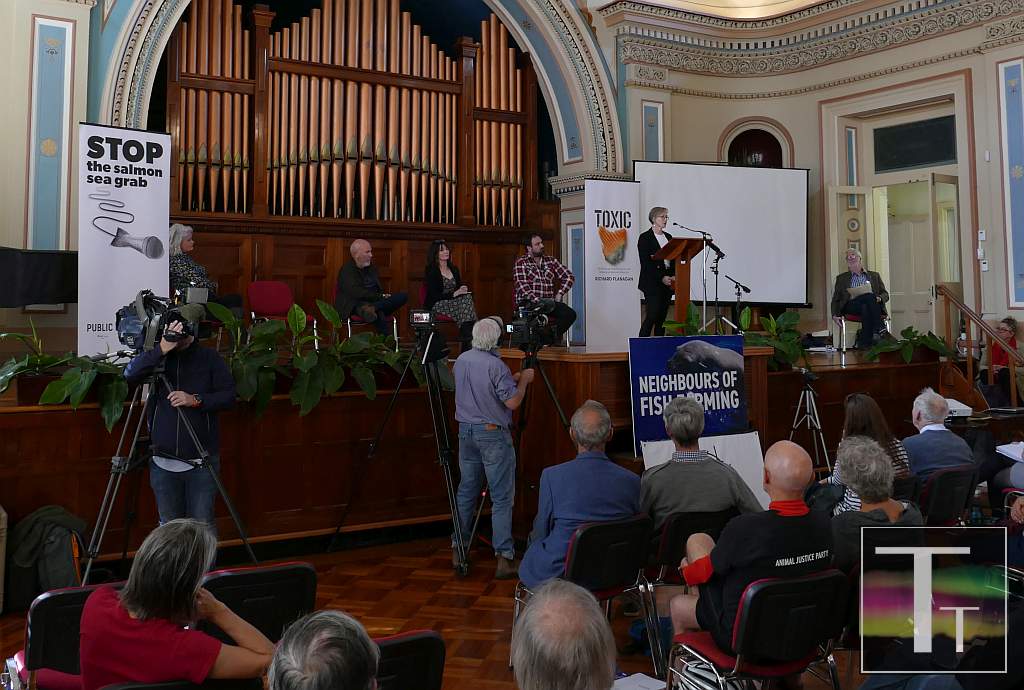
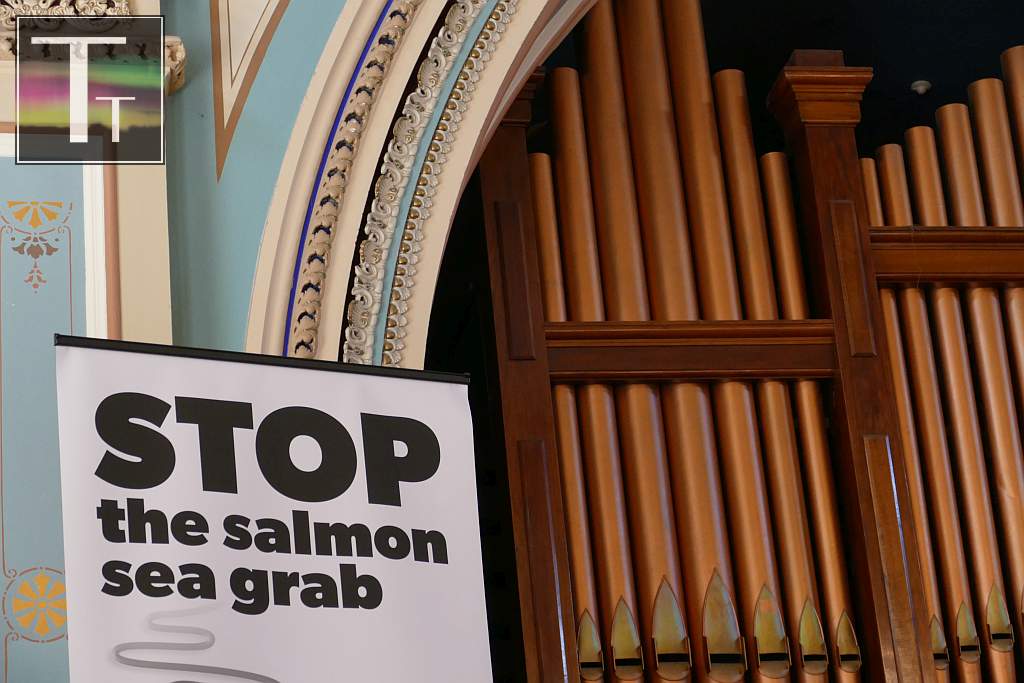
Transcript of ‘Stop the Salmon Sea Grab’ public meeting hosted by Environment Tasmania and Tasmanian Alliance for Marine Protection at Hobart Town Hall, 28 April 2021.
Peter George
Hello, and welcome to a public meeting jointly held by Environment Tasmania and the Tasmanian Alliance for Marine Protection. I wish first to pay respects to and honour the palawa people, the island’s first inhabitants, to those who have passed on and to those who are today’s custodians.
We’re quite privileged today to have five distinguished guests. So I’ll introduce them first, if I may. From your right: filmmaker Justin Kurzel; actor and Bruny Island resident Essie Davis; author Richard Flanagan; environment consultant Louise Cherry, and Environment Tasmania Director Laura Kelly.
My name is Peter George, I’m the co-chair of the Tasmanian Alliance of Marine Protection and a former ABC correspondent and Four Corners reporter for what that’s worth.
We’re here today because an entire island is belatedly waking up to the growing threat to some of our greatest treasures, which are the seas and waterways that define the island of Tasmania. Some of that threat is beyond the control of individuals and demands intervention of nations, obviously warming climate, warming seas. But as individuals we can affect change and we can demand change. We need only to acknowledge that the standard we walk past is the standard we accept.
Richard Flanagan as author and Justin Kurzel as filmmaker made a courageous decision to stop walking past the standards set by big salmon and its enablers in government. They did it knowing that they would be demonised which is what happens to prophets in their own land. They’ve taken on a voracious and bullying industry, a political establishment that does its bidding and a bureaucracy that is too tame, too underfunded and too timid to apply even the lax regulations that supposedly govern the island’s Atlantic salmon industry. They deserve a lot of gratitude for that. So a big thank you to Justin.
There are 100 Toxic books at the back of the hall. That is Toxic, the rotting underbelly of the Tasmanian salmon industry. I understand they are the last available for sale in Tasmania until the publishers rush out their fourth reprint in less than 10 days. Someone from Penguin has told me I’m not allowed to say this in public anymore. But this is a real page turner. And let me tell you, it is a grand piece of investigative journalism wrapped up in a marvellous piece of literature. It’s eminently readable and it stands as a challenge to the industry, to the politicians of Tasmania, and to all of us facing one of the largest industrial expansions in the state’s history to grow this industry to $2 billion a year within nine years. We need to decide we will not walk past the standard that none of us should accept: the theft and despoiling of the waterways in the name of greed. We must demand a halt to the sea grab that is inevitably coming to feed big salmon’s massive expansion plans. We must demand the government reveals the secret deals it’s doing to lock up vast swathes of our waterways and hand them over for a pittance. And so to our speakers, who really need very little introduction, filmmaker, Justin Kurzel.
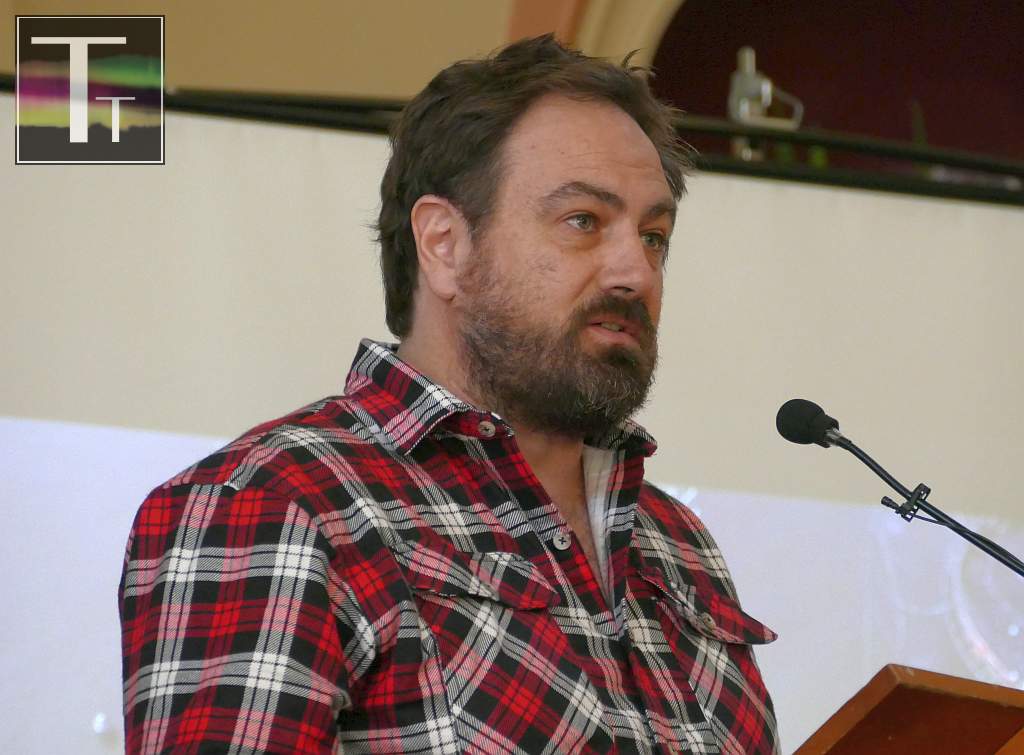
Justin Kurzel.
Justin Kurzel
It’s a privilege being here. Thank you. I moved to Tasmania, from London, because I wanted my children to grow up in the most beautiful place in the world really. We found a home along the D’Entrecasteux Channel, which we thought would be peaceful and clean. But that wasn’t to be. The channel started dying around us. The fish disappeared, the water felt dead. Algae blooms started to litter the shores and the industrial sounds of the fish farms opposite us drowned out the natural life around us. I asked questions from the farm, complained endlessly, but the answers which came back were unsympathetic and ignored. So I decided to find out myself. What was behind this fortress, which is the salmon industry? I made a film I thought at the time it would be a small one. But it grew and grew. And when I came across an endless amount of Tasmanians, who were as frustrated and as angry as me. These voices were ordinary Tasmanians, but their stories, their passion for this place, was extraordinary. One by one Connor, who made the film with me, heard these stories of arrogance and inaction from an industry that has gone rogue. Of people’s lives which have been destroyed by this industry who cared little for the other Tasmanians, and even less for the pristine waters in which it farmed.
These companies like to say they are real Tasmania, that they are green, clean and sustainable. But what we discovered was an industry which was tearing communities apart, and growing fish without concern for the damage it was causing in the waterways.
Despite these voices in the film, feeling angry and desperate, there was an extraordinary strength behind their cries, a courage which inspires. I no longer felt alone in my sadness, but I’ve got strong amongst the many. And there are many out there who are sick of an industry which takes takes takes and is allowed to do as they please. This film that will be shown today is it’s a taste of what we filmed and is a bigger film that you can see on The Monthly website. It was a film made with no money. It was made through the extraordinary generosity of others of people that have been voicing their concern for years. And to all of them and I know there are some here today, Connor and I would like to say thank you so much for your courage and your tenacity and your strength. Thank you.
[film shows]
Thanks. All right, please go to The Monthly website and have a look at the full film. It’s 23 minutes. We’ve had an enormous reaction to the film by people all over the place who have come forward now with new stories. And we’re now talking to a major film production company about developing this into a feature because this is just the beginning. And there are so many more stories that are coming out and we feel as though they need to be told in a longer form. So thank you.
Peter George
Thank you. To my knowledge, his film’s already been seen in a number of South American countries, in Canada and in Japan, and I’m sure in many other countries; I’ve been contacted by organisations in all those countries. As Justin says, you can see it online. My suggestion is that you search The Monthly ‘Toxic Flanagan and Kurzel’ and you’ll find yourselves in the right place. Richard Flanagan’s dedication in Toxic is as brief as it is telling. He writes ‘for all the brave women who helped me write this book’. One of those brave women is Louise Cherry, an environmental specialist who resigned from the government advisory panel that inexplicably supported the salmon industry’s expansion into Storm Bay. So we welcome her today on a rare public appearance, Louise Cherry.
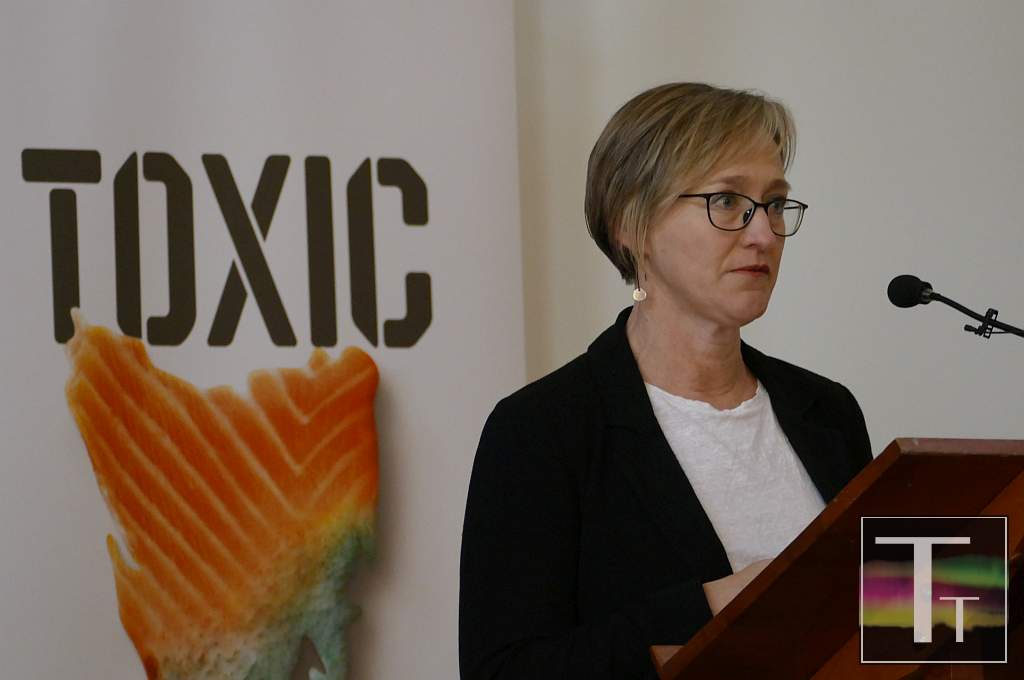
Louise Cherry.
Louise Cherry
I’m here on behalf of both Professor Barbara Novak and myself. She couldn’t be here, but she’s highly supportive. We want to let you know that we stand with you. I want to just briefly say why we joined, why we quit and what happens next. So Barbara asked me also to pass on her reasons for joining. We both joined the panel because we were wanting to contribute to a sustainable industry. We’re the ones who tried to do that through you know, playing within the rules. Let’s do it from inside. So we both joined, Barbara with over 30 years in salmon and biosecurity, experience in aquaculture research. This is a globally recognised scientist. I joined with over 25 years in environmental management, I look at assurance and due diligence. So between us, we joined hoping that we could contribute to an economically, environmentally and socially sustainable development in Tasmania. That’s what we wanted, supportive of salmon, but there’s a big caveat on that.
The more we looked, the more concerned we became. Our questions were inconvenient to say the least. We still believed for a long time that we could affect change. I did my own due diligence. Outside of panel meetings, Barbara provided a myriad of global experiences backed up by research. Unfortunately, we weren’t be able to influence or make the change we’d hoped, in effect we failed in our efforts. And it was with a lot of reluctance that we resigned, not wanting to put either of our reputations on the line by being involved in such an abominable decision.
So resignation came, we couldn’t help the panel, we couldn’t influence that decision. We also resigned thinking, ‘you know what, this is going to be meaningless. Our resignation is going to go quietly and nobody will actually care’. What I want to do today is to say thank you to each and every one of you for validating what we did, because we’ve been reasonably alone for a long time. I want to thank Justin and Connor for an amazing film. I want to thank Essie for her profile that she brings to this and her passion. I want to thank Laura for sustained efforts in this area. And there are a lot of people in the room who’ve just been quietly agitating, Dr. Lisa Gershwin, Mark Duncan, I’m not sure whether he’s here. People who quietly go about trying to effect change, I want to say thank you.
Richard’s book, I think, creates a new genre: non fiction horror. I’m not sure it existed before.
So what I also want to do is to validate every one of you that’s here, there’s a scientist in all of you. The basis of good science is observation. Now you have observed something in your lives that’s brought you here today, whether it be the fact that you can’t walk down the beach you’ve walked for 20-30 years, without noticing the step change decline in health. You can’t go out and fish the same areas that you fished for 20 years, something has changed. Those observations are valuable. That is community science. And I want to thank you for that. And I feel validated by you being here. But I want to validate your observations by saying: you are right. There is something wrong with this. And you don’t need science to tell you that, it’s just a useful backup. So that’s really all I wanted to say. Thank you and thank you to everybody here.
Peter George
Louise Cherry. Let’s not forget that anyone who challenges the salmon industry or the Tasmanian government for that matter, finds themselves on perilous grounds. And that’s why you saw faces blanked out in some of that film. Many people come to our alliance, and to the community organisations that sit under our umbrella, and talk to people like me because they’re afraid of complaining about the salmon industry and what the ramifications will be. So that’s why these organisations exist, so we can speak up for those who actually are afraid to speak up for themselves and all the people like you who who feel dedicated to this. Laura Kelly’s one of the brave women who is acknowledged in Richard Flanagan’s book. Few people have done more to uncover the dark secrets of Tasmania’s industrial salmon industry in her role of Environment Tasmania’s Director. So ladies and gentlemen, Laura Kelly.
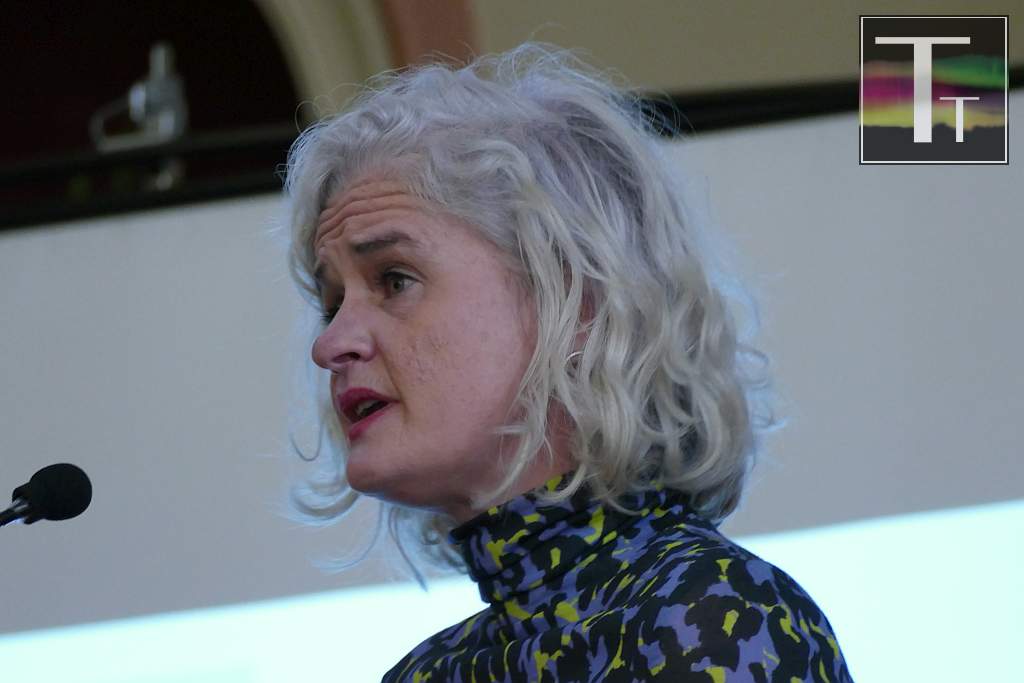
Laura Kelly.
Laura Kelly
Thanks. I’ve got a geeky campaigner presentation so I apologise for that. Since the last peak in community campaigning against big salmon which Four Corners launched with (inaudible) in 2016, the community has delivered a number of wins against the salmon industry, including having the size of the expansion in Okehampton Bay, cutting biomass in Macquarie Harbour, forcing WWF and Australian Ethical Investments to end their financial relationship with Tassal. But small wins just haven’t been enough. The industry is still massively expanding. And it’s not just greenies saying that. It’s reflected in global production figures where the spike in global demand is attributed to rapidly expanding new producer nations like Australia.
So you may have heard Richard speak about its secret expansion plans that the government’s doing behind closed doors with industry across the north coast, but communities in the southeast that are already bearing the brunt of the noise, the pollution, the algal blooms, need to be prepared for expansion and intensification as well. And so the Tasmanian government has paid IMAS to do a spatial planning project for the Bruny bio-region. It uses the language of marine spatial planning that has delivered good outcomes for the community in the environment in other states, but it is utterly stacked by industry. And its first key deliverable is mentioned as looking for waters around Bruny that are suitable for the intensification and expansion of salmon farming.
So there’s two things that are driving this demand.
It’s ever increasing demand for the product, as well as Tasmania’s major parties’ ideological dependence on corporate primary industries to create a tiny amount of jobs in regional areas.
So massive increasing demand for the product. That explains the company’s own marketing campaigns and Tassal’s ‘I’ll switch it to salmon’, and Huon Aquaculture’s ‘give chicken the night off’. It’s all about increasing community consumer demand on the Australian mainland.
Salmon prices follow consumer confidence and demand. Our talks with investors indicate that we’re unlikely to see divestment from mainstream investors until there is a dent in that consumer demand and confidence. So if we as a community can impact consumer confidence, we can halt expansion in our waters. That’s why Environment Tassie for the past year and a half or so stopped campaigning in Tasmania essentially, and focused all of our energies on the mainland. So through our celebrity chefs’ work, we’ve got chefs like Maggie Beer, Matt Moran, Matthew Evans, they’ve all signed a chef’s charter saying they don’t want the worst salmon. Increasingly, we’re finding celebrity chefs like Melissa Anderson and Peter Gilmore at (inaudible), don’t even want to sign the charter because they don’t want their brand associated with salmon in any way. So there’s there’s been a significant shift over I’d say about the past two years in the culture around salmon use amongst food influences,
Our main way of engaging with retail consumers has been digital marketing. So we’re working through animations, with chefs, actors, athletes, doctors, scientists, to really hammer home the worry points for consumers. So their map tons of antibiotic use, flesh colouring, fish…their dinner swimming over mounds of faeces covered in bacteria being eaten by worms. And things like shooting seals in the face; a bit of a downer at dinner time. So, this is the type of reaction we’re getting from consumers. So we’ve segmented our messaging between a greens audience, a fair food audience, and health conscious mums. And so this is coming from Tassal’s audience, not our audience. We’re doing best with mums that don’t engage with the green movement. We’ve had about 3 million visitors to the website in the past couple of months, about 26,000 animation watches, and about 16,000 people have signed our petitions for supermarkets asking them to stop selling the worst salmon.
Supermarkets are the most crucial buyer on the mainland. They’re the most concentrated buyers and sellers of salmon. But exports have recently increased. So this year, we’re going to expand our markets campaign to talk to global importers and international chefs. You can see some of the reactions from people that just didn’t know the information about the antibiotics, the flesh colouring and the shit. Yeah, they just say ‘Oh, thank you, I had no idea, I think twice before eating it’. Some are just sticking to the emojis, which is fairly clear as well. So there’s just such a disjunct between the way this industry market its product, and how healthy the product is, and the actual truth of how it’s produced. That makes the industry exquisitely vulnerable to a consumer markets campaign. So if we can scale this work, I really believe we can win and halt further expansion in our waters.
Peter George
Laura Kelly, thanks Laura. Her message actually needs to be taken up by all of us, most of us will have relatives friends on the mainland. And as Laura says, that is the target. So the one thing that we can all do is tell our friends that we don’t serve and we don’t eat salmon. I’m sorry to say that our next speaker is such an identity that I’ve found nothing original to say about him at all. So all I can really say is he is the man who lit the fuse and then didn’t stand back. Author Richard Flanagan.
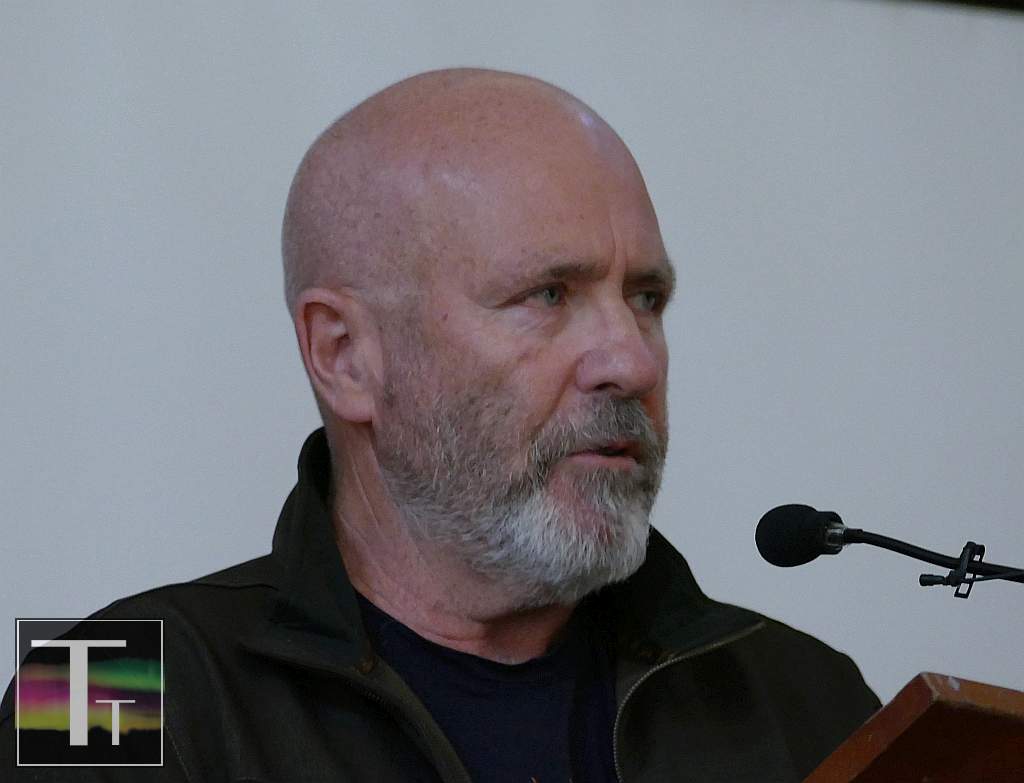
Richard Flanagan.
Richard Flanagan
Thank you. First, I do really want to thank all those brave people who had the immense courage to speak with me and Justin, knowing their careers, their jobs would be threatened. And, and as you will read in the book, often these threats, this bullying, this intimidation is real. And without those brave people, particularly those brave women – Louise, Laura – Justin and I couldn’t have done what we did so a big hand for those people. (applause)
There is a story, a Tasmanian story, and it’s the same story over and over. It’s the story of gambling. And it’s the story of forestry. And it’s the story of the Hydro. And it’s a story that goes all the way back to the invasion and the war with the palawa, the attempted genocide and the slave society from which we come. It is the story of power serving only itself demanding with fear and menaces that we agree and submit.
That is why the battle that is now beginning against the salmon industry is for Tasmanians more than an environmental or community issue.
This is a battle for our island’s soul.
The moment we finally put an end to two centuries of fear and walk into the light of the 21st century a new people, a free people.
It should be self evident that using Hobart’s drinking water catchments, as – in the words of one scientist with extensive experience working with the aquaculture industry -sewerage settling ponds for salmon hatcheries, is not just wrong, but profoundly dangerous. That risking the heavy metal contamination of some of our most popular wild recreational fisheries with mercury poisoning, as other scientists have pointed out, is not just careless, but potentially criminal. The firing of nearly 40,000 seal bombs in 2016 at defenceless seals – creatures that in South Australia, there is a $100,000 fine for killing – is not just indefensible, but a program of systematic animal cruelty. That the destruction of one heart world after another heart world along our coast is not just intolerable, but immoral.
And yet it is not self evident. These things should be the subject of a full judicial investigation by our government. But in Tasmania, they are not, and they will not. I cannot publicly explain to you the curiously close relationship between our leading bureaucrats, leading politicians in the salmon industry. But I can’t say this much. It has to end. It has to end so that the Tasmanian salmon industry has a future rather than a crashing. It has to end so that Tasmanian salmon workers have jobs in the future in a properly run industry, rather than risk of the collapse of the entire industry. And with it has to end 200 years of fear and silence so that we all might have a better future with a new story for us all to live by.
For it to end, we need to understand that we Tasmanians must now fight, that this will be a long fight. And it will be a hard fight. But this is not Tassal’s Tasmania, it’s our Tasmania. (applause) It is not Huon Aquaculture’s or Petuna’s Tasmania, it is our Tasmania. And it is our way of life, our culture, that demands respect and honouring of our waterways and the miraculous gift of creatures and life, which need protection, not contempt and destruction for the profit of a few.
The EPA and the marine farming branch need to understand that time is up as the salmon industry’s enforcers, enablers and cleaners. And the politicians need to know that their secrets and lies and silences will not prevail. I want to tell the good people of breadboard of Stanley of the coast from Burnie to the west of Wynyard, round Hunter Island of what is coming for you.
After the election, the government whether Liberal or Labor will announce a sea grab: a coastal lock up of our waters that will have already been decided by the salmon companies. There will be a costume of new words and terms and new promises of science and consultation. But it will just be one more cynical act of profound bad faith on the part of government.
It will be just like it has ever been since 1985 when the science was ignored and they put the farms in D’Entrecasteux Channel against the advice of the Norwegian specialists who set up the industry here. It’ll be like when the expansion into Macquarie Harbour and Okehampton Bay happened against all expert advice. It will be just like in Storm Bay, where even the possibility of mercury poisoning of a major recreational fishery couldn’t stop the expansion and the salmon industry’s greed.
You, your community and the science will behind closed doors be completely ignored. The only guarantee is that the decision was long ago made by the salmon industry and will be endorsed by government bodies and boards and bureaucrats in bad faith, garlanded with sickening lies made by the politician at its end. And then the floating feedlots will start ringworming along the northwest coast, locking up your seas and bringing a long slow death to your fishing grounds. Your beaches will slowly slime, your bays will fill with silt and grow algae; jellies, fish and seals will proliferate while so many other sea creatures will vanish and whole ecosystems will begin a slow but inevitable collapse.
You will go to government agencies and you will be ignored. You will discover that when it comes to salmon companies, you have no rights as a citizen. That there is one law for Tasmanians and another law for Tasmanian salmon companies, that when you complain your complaints are not heard. The glorious, beloved ocean horizons of the north will fill with the light and noise of heavy industry. Stanley, once one of the most beautiful of all Australian historic villages, will become a heavy industrial hub with noise and light 24/7. You will go to the politicians and they will do nothing. And then you will go to the companies and they will lie to you and they will deceive you and they will betray you.
And when some of you rage at what is happening, in despair as you watched your beautiful north coast begin to die, a few of you will stand up and bravely speak out. And then you will get the late night call that seems to be such a speciality of this industry, threatening your business, your name, your job, your future, because that’s how the salmon industry does business in Tasmania. And that is where we have got to on this beautiful island.
And that is why sadly the election on Saturday is the end of nothing. We know the salmon companies are silent in the expectation that the major parties will be returned to power and that they will continue to allow the salmon companies to do as they wish, how they wish, when they wish, with our drinking water. With our coastal waters, with our heart places, with our way of life.
And I am here today to say one thing: it is over. it may take years but it is over. Because we are not going to stop fighting. We are not going to stop calling out their abuses until it is over. Because we Tasmanians are better than they are. Because whatever your politics, your backgrounds, we share a belief that this island and thus are joined. And we will not allow what we’d love to be destroyed because we are destroyed with it.
There are hard days, disappointing days, bitter days and months and years to come. We have to organise, we have to stay the course. We have to endure a long, long winter. But I promise you this. We shall prevail and we shall win. Because in the end what remains, what is indestructible, is our love of our island. Today is the beginning of when Tasmanians began to fight for Tasmania, for their heart worlds, their soul country for our future, for a new and better story for us all. Instead of the old tales of destruction, bullying, and the powerful taking all.
And in that long struggle, we will not turn away. We shall prevail. And we shall win. Thank you.
Peter George
Today’s news from the Atlantic salmon industry, hidden front page, is that the marine farming branch and the EPA have received reports that one company has dumped mussel-laden nets too heavy to clean on the seabed and leases off Soldiers Point in the south of Bruny Island. Too filthy to move. They’ve reportedly been dumped there to rot on the seabed. So it wouldn’t be a bad idea if everyone in this room writes, or rings or emails, the Environment Protection Agency to demand to know what’s going on.
What we’ve heard here today amounts to an expose of the toxic salmon industry as it is today. But worse is to come. This is an industry, as Richard says, hell bent on a corrupted process and encouraged by compliant politicians to expand. Today has been a call to arms you might say Richard is crafting the spear, Justin has honed it, and our job is to throw it. So finally friends I’m going to call on Essie Davis to ask for your support for last year’s Dennes Point Declaration.
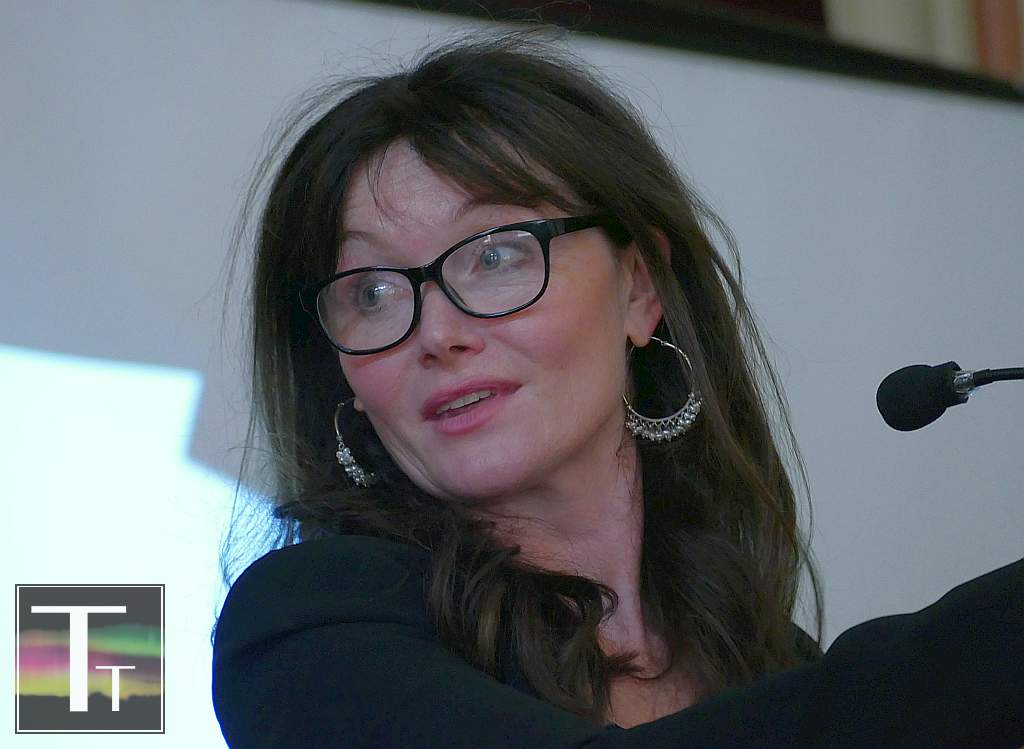
Essie Davis.
Essie Davis
Thank you, Peter and all of you for talking and all of you for coming. This is very important.
This Declaration was first made on the northern tip of Bruny Island on October the 16th last year and delivered to the members of the Tasmanian Parliament. It is a cry from the heart to turn back the inexorable expansion of big salmon before it’s too late. It was signed by concerned individuals and community organisations And much of what you’ve heard today is directed towards the declaration’s simple objectives.
It reads:
In support of all Tasmanians, who recognise the coasts and waters of our island as their heart country.
In recognition of the globally significant riches of Tasmania’s marine world and to ensure a Tasmanian agricultural industry that will endure into the future.
We call for: 1) a moratorium on any new industrial fish farms in Tasmania’s coastal, estuary and river waters.
2) an immediate government led transition out of the sea and into land based farms.
3) an independent, empowered and resourced regulator guided by independent science and community values.
Peter George
Thank you Essie. We would, with Essie’s assistance, we’d like to put two propositions to this meeting to seek your support.
Essie Davis
Here’s the first motion: We call on Coles, Woolworths, IGA, and other suppliers not to stock Tasmania’s Atlantic salmon until the state government and industry adopt the Dennes Point Declaration as a framework for industry sustainability.
Peter George
So time being short, I’m going to put that to our meeting without discussion. May I ask for a show of hands or applause for those in favour? (applause) Those against. (silence). That looks quite unanimous to me.
voice from audience
And Salamanca Fresh.
Essie Davis
Yes, Salamanca Fresh, all of our local suppliers and all of our national suppliers. Yes, Hill Street is IGA. And all of our seafood sellers on the mainland as well. Thank you for that support. As you know, big salmon and the government have announced plans for the industry to double in size in nine years. And that means a massive sea grab is on its way.
So the second motion reads: We call on Premier Gutwein to reveal before Tasmanians vote, the coastlines that will be locked up for massive industrial salmon expansion, so that communities can express their views at the ballot box.
Peter George
Thank you, Essie I’m not going to put that to a vote for those in favour. What about those against? And be warned. (silence)
Thank you to our speakers for coming. And speaking with such passion. Thank you all for coming and showing your passion. You need to let people know especially those you know on the mainland that eating salmon is not clean. It’s not green, and it is not healthy. And it’s not healthy for Tasmania. And it’s not healthy to eat. You need to speak boldly to government and to industry. No more sea grabs, no more secret deals. No more taking of our public waterways. Big salmon’s social license has expired. And until they move into land-based production, they’re no longer welcome here.
Thank you for coming. And for those of you who think that you might have a taste for the new genre of nonfiction horror, Richard’s book is for sale at the back of the hall in that small ante-room and he’s kindly agreed to sign copies of it. Thank you so much for coming.
TAMP: Salmon Farming – Map & Backgrounder.
TASMANIAN TIMES: ‘Stop Eating Tasmanian Salmon’.
TASMANIAN TIMES: Killora Lodges EPA Complaint over Salmon Farming.